Tag: Short Story Reviews

  • Flash Fiction Review – “What Kira Packed” by Heather Bell Adams

    (The flash fiction story “What Kira Packed” by Heather Bell Adams was first presented by Milk Candy Review on December 11th, 2025.)

    (Image from Milk Candy Review)

    You know what “writing advice” I hate getting more than anything? “Less is more.” And the hair’s breadth of a runner up to that infuriating maxim is, “Show don’t tell.” These two bits of advice are the Tweedledee and Tweedledum of the writing world, who get marched out by lazy editors and inept writing instructors when they need to say something enigmatic yet mildly profound, which can be interpretation in any way, other than with a coherent explanation. Those two phrases have been used so often, that the words have been rendered meaningless.

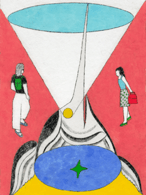
    But then Heather Bell Adams writes “What Kira Packed,” and finally, there is an articulate, rational, and svelte work of flash that says in a clear voice – this is how you write less without telling.

    This piece is under three hundred words, using a structure devise of what Kira packed going to and then back from “camp.” It is heartbreaking in its simplicity, knowing the “change” Kira endured at “camp” and how what she’ll be coming home with what may include trauma, repression, self-loathing, and depression. This is a gut-punch of a piece, a brutalist’s honesty here, but Heather Bell Adams also leaves just enough vague, forcing us to use our imaginations to fill in what is left undefined. This creates a unique and individual horror for each of us as to what “really” happened at this camp.

    This is how you do it, and do it impactfully, with intent to get to the marrow of a story.

    Bravo.

  • Flash Fiction Review – “To the woman who conducted my disability benefits interview” by Angela Kubinec

    (The flash fiction story “To the woman who conducted my disability benefits interview” by Angela Kubinec was posted by Flash Boulevard on September 28th , 2025.)

    My mother was a nurse, and she loved helping people. It wasn’t a job; it was a calling. I say this because she told me often that she never saw people at their best. When you show up at the doctor’s office, and especially at the hospital, people are usually at their worst, and don’t always behave well. She would try to approach each patient with a level of empathy, knowing that the person just wanted to feel better, and a little kindness goes a long way. Reading Angela Kubinec’s flash fiction story “To the woman who conducted my disability benefits interview” touches on this theme, and uses a format to reinforce that idea.

    Three main tenants landed with me as I read this piece. First is the protagonist/narrator who wrote this letter to the social worker. I was touched by the humanity of this person. Though it is never fully identified what the disability is for the protagonist, medication bottles and past delusions are mentioned, so a possible mental disorder seems applicable. This character has a nervous frantic energy, but at the same time feels like they are doing their best to hold it all together. Through it all, charming bits of humor and vulnerability peek through. The second part of this story that intrigued me was how the social worker is described in this letter. From the start of the story, the social worker’s annoyance is almost tactile, and she is covered in a harried tiredness which exemplifies a person who is overworked, and underappreciated in the essential job they perform. She is presented as a person who has seen and heard it all before when it comes to these interviews. This creates a simple yet very effective tension between these two, but humanity and sympathy still finds ways to bloom forth in this situation. This lead me to the third point, which is how Kubinec’s use of the letter as the structure to frame this story. Though this isn’t a formal letter, using this format elevates the emotional impact of this situation. The protagonist, the writer of this letter, states that this incident between them occurred years ago, implying clearly that these events have stayed with them. That this act of simple kindness has had weight and impact on their life. By using the letter format, or second-person narrative if you will, the social worker is the target audience, leaving us the reader in a role of witness to the protagonist’s unguarded honesty. It’s as if we are being let in on a secret, instead of being told a story.

    “To the woman…” is the kind of flash fiction story that reminds me not to give up on humanity. Just a little sympathy and kindness can help others in immeasurable ways. Perhaps not the most original theme, but a vital one, and one that in the time that we live in, we desperately need reminding of.

  • Short Story Review: “Light Secrets” by Joseph O’Neill

    (The short story “Light Secrets” by Joseph O’Neill appeared in the January 26th, 2026 issue of The New Yorker.)

    Photograph by Eric Helgas for The New Yorker

    Got another “Can’t Put My Finger on It” short story. (It’s doubly funny because hands come into play with the work.) I have come around, and I will say that I do like Joseph O’Neill’s “Light Secrets.” And I did come around to it, because when I finished reading it, I wasn’t sure exactly what I had read. “What is this?” I said out loud in my car. See, I was in the process of moving my car for the street sweeper, but the sweeper hadn’t arrived yet, so I decided that I should read this story. The sweeper never arrived, so as I walked back to my apartment, I contemplated what I had just read. And my opinion began to change.

    Though “Light Secrets” is a contemporary story taking place in New York City, it feels more akin to a late 70’s early 80’s New York – like in a Woody Allen movie. You know, smart professional people in their 40’s with leisure time to lunch, walk the City, attend friendly dinner parties, and enjoy robust social circles. I’m not bringing this up as a criticism of the work, more to establish the setting and mentality of these characters; their lives have a breath and space to them which allows for internal contemplation, and though they all have outside pressures in their lives, none of those pressures are paramount to define their being, but are more like accessories to highlight characterization. For a story like this to work, you have to believe that these characters are the type of people that would take the time to analyze and digest what their friends say and how it may apply to their life, and not just move from moment to moment.

    And with that said, I’m not sure what “Light Secrets” is trying to say, but I liked it. I like the sensibility of it. How the protagonist speaks to us like we’re a friend. I like how things are left undefined, and rough around the edges. How moments seem to have an intersection, but maybe it’s just a coincidence? Does the touching of hands mean anything, or is it just something that happens? Can a lifetime of good deeds be undone by an unconfirmed rumor? Should it? I kept finding myself going back and thinking of the old adage, “If a tree falls in the woods, does it make a sound?” Does a good deed have to be acknowledged for it to have impact and relevance? Is existentialism just dumb luck which we have thought too much about?

    I hate to admit it, but I am a sucker for stories like this – undefined and leading to interpretation. You know, which door has the tiger behind it, and stuff like that. “Light Secrets” is right up my alley, and I think O’Neill did an excellent job of balancing his story, in regard to the information we are given, and the information left out. It’s a well thought through work, and I appreciate that it required me to slow down a step, and just contemplate life for a bit.

  • Flash Fiction Review: “Bed Rot” by Sarah Chin

    (The flash fiction story “Bed Rot” by Sarah Chin first appeared on November 14, 2025 at Okay Donkey.)

    If you read enough flash fiction like I do, you notice that a couple of subjects are rather popular with writers; death, pets, and breakups. This isn’t a complaint, as I understand why – the three I named bring up strong emotions in people. Breakups are an especially tricky one, as the writer has to thread a very fine needle – don’t want to be too angry and come across as bitter, and god help you if you are too whinny. The best breakup pieces, I find, work in a healthy amount of humor to balance their pathos, which is why Sarah Chin’s “Bed Rot” is such a fun and honest work.

    You can never go wrong with a good opening line, and here Chin delivers a sentence that at first hints at a promise of possibility only to end with the foreshadowing of what is actually to come. Word choice, and sentence length is used here to create a staccato rhythm that keeps the piece moving in spurts and prolonged moments. This creates a feeling that nothing is centered or even fully processed; that what the speaker is experiencing still has a level of shock to it, but also balanced with a desire to try and stay in control of their emotions.

    Another aspect of the piece I enjoyed was following the path of thoughts the speaker has, and the logic it traverses going from subject to subject. From tulips, to the other woman’s name being Amsterdam, Martha Stewart’s idea of women and flowers, from the shedding of the brunch date outfit to be comfortable, and a little tulip madness thrown in. Peppered in each subject are dry comments, and observations that are sharp-tinted with a hint of anger, but tempered with humor. Nothing spins out of control, though it feels like it could, yet never does.

    “Bed Rot” does stick to a structure which dramatically works very well. Each subject change, and snarky comment is building toward the climax of the speaker expelling this relationship and its confinement to her. What she is left with is a raw, more authentic self, thus completing this journey, and leaving us with the understanding that she will continue to grow and be fine.

  • Short Story Review: “Safety” by Joan Silber

    (The short story “Safety” by Joan Silber appeared in the December 8th, 2025 issue of The New Yorker.)

    Illustration by Chris W. Kim

    You know, every “time” is a “historic time” but some are more historic than others. I will agree that we are in the middle of one of those historic times, and if I am lucky enough to have grandkids, then I imagine they will ask me “WTF was everyone thinking, grandpa?” The good news is that over the past three or four months, I have started to see works of art in different media start to tackle the events of deportation, disappearing, and what effect these policies will have on America. I am going to throw Joan Silber’s “Safety” in with all of these works, though uneven, I applaud what this story attempted.

    Overly Simplified Synopsis: Two girls become friends growing up in New York, one Muslim the other Jewish, and both decedents of people who immigrated to the US to escape dictators. They go their separate ways in life and reconnect in New York, where the Muslim friend now has a child and a partner who is a comedian. When the comedian is on his way home from a gig, he is disappeared by the Administration.

    There is an ease to this story, and a simple directness to the writing. What it does well is create a picture of the modern melting pot that America is – people of different backgrounds are still coming here, and their children are still connecting with people that are different from them, and finding a commonality in our shared humanity. Silber does well in creating a context for the Muslim family regarding escaping the Nazis, being forced to migrate by Stalin to Uzbekistan, and the trauma of family separation.

    Yet, through it all, I couldn’t shake the feeling that this story was pulling its punches. There is a huge amount of drama here that is being sieved through a philosophical existential filter, but it never seems to amount to an emotional climax. For example, think of how these families lives’ have been influenced by authoritarians – from being pushed out of home nations, to being pushed together in America – and how these families have made new lives for themselves. And when a new Authoritarian pressure is applied, the characters seem more resigned, as if ordained to this fate, rather than free to exist.

    Ultimately, I appreciated this story, and Silber, for taking a swing at an issue that needs to be swung at. “Safety” uncomfortably reminds us that history does repeat itself. That immigration, deportation, and citizenship (both in its legal and the social definition) needs to be discussed and debated again, so we can finally find a way to break this awful cycle.