I have been thinking a lot about what would make me happy. Is there one thing, that if it occurred, I would be happy from now till the end of my days? I mean, is that even possible?
I have this feeling, a thought in the back of my head, that there isn’t one thing that brings about happiness. Happiness is attained, and also is a choice.
And, an additional $500 a month would get me really damn close to being happy.
I guess what I’m saying is that security also is a form of happiness.
Maybe fulfillment? That can bring about happiness. So.. yeah, sure, I’ll go with that; fulfillment.
You know, about five years ago, I had a phone interview for a prestigious job in San Francisco, which would have had me working for this really important theatre school. But to be honest, I don’t remember the name of the theatre school, so it wasn’t that prestigious. Anyway, I was on the phone with the head of the whole place, someone very important, and we are hitting it off, and I felt like the job is going to be offered to me. Then the head of the place asks me if I could do anything, what would I do – I didn’t miss a beat and said confidently, “I would be in a cabin in the woods, reading books, and writing.”
There was a long pause, and I knew that in this pause was the silent sound of this job slipping away because what I should have said was something along the lines of, “Working at this school,” or “Doing theatre,” or anything relating to the job, and not the truth of what would really make me happy.
Or…
As I try to ret-con this part of my life, maybe I finally admitted out loud what I really want to do with my life to be happy.
(The short story “Heart” by Shuang Xuetao appeared in the October 9th, 2023 issue of The New Yorker.)
Illustration by Sally Deng
If you write a story about a parent/child relationship, and then throw in a dying parent, you pretty much are half way to claiming a small place in my heart. My logically analytical side gets thrown out the window, and I am running on emotions. And let’s be honest, if you’re creating art, you want people to have an emotional reaction – it’s like the whole point. I say this because I can be completely biased when it comes to certain subject matters, which can complicate things when I try to review short stories from an objective place.
Which is why it’s strange for me to say that I didn’t feel an emotional connection to “Heart” by Shuang Xuetao. This is a fine story, well written, engaging, and just odd enough to keep me intrigued with what was happening. And as I was reading this piece, I kept expecting it to “click” into place and tap that raw parent/child emotion in me, but it never came. But I don’t begrudge the story for this, nor am I left feeling that the story “misfired” in its execution. Oddly, I feel this might have been exactly the reaction the story was attempting to create in the reader.
The story mainly takes places on a medical bus that is driving late at night to Beijing. The passengers are an older man dying of heart disease, his son, a driver, and ER doctor who agreed to accompany the father and son. We learn from the narrator, who is the son, that the heart disease that is killing his father skips every other generation, meaning the son is immune from the fate of his father.
The tone of the story is straightforward, logical, and there are no literary flourishes. But the events in this story slightly graze the edge of surrealism – just slightly. It’s enough touches to make the story feel that it’s not completely in reality. But still I had to wonder why these touches were there. What did the father’s daily boxing routine really symbolize? Why was the driver sleeping as he drove the vehicle? Also, what about the doctor’s sleeping? Was this all a dream? And the need for the son to have to use the bathroom? Was there a meaning to the son’s self-described laziness and his recent decision to stop working, while the father worked every day; even when he retired, he went and found a new job to keep working? All of these questions left me feeling uncertain, unsettled, and wondering what I was supposed to make of this?
And then there is a moment in the story where the son wonders what he is supposed to do when his father does pass away. He thinks of all the work that will come with making the arrangements for a funeral; contacting family and people his father worked with, raising money to pay for it all, and cars for the procession. Then the son thinks that once his father is gone, that he will truly be alone and by himself. To that the narrator says, “I guess that’s what freedom looks like nowadays,…” A sobering, and heartbreaking realization, that can also feel overwhelming to the point where one can be left numb, and disconnected.
There isn’t one way to mourn, and that’s what “Heart” reminded me of. I don’t know what all of these pieces in this story amounted to, but I don’t think Shuang Xuetao is wrong for presenting that either, if that was the intention. Maybe not having a feeling right away is still a sort of feeling. Maybe.
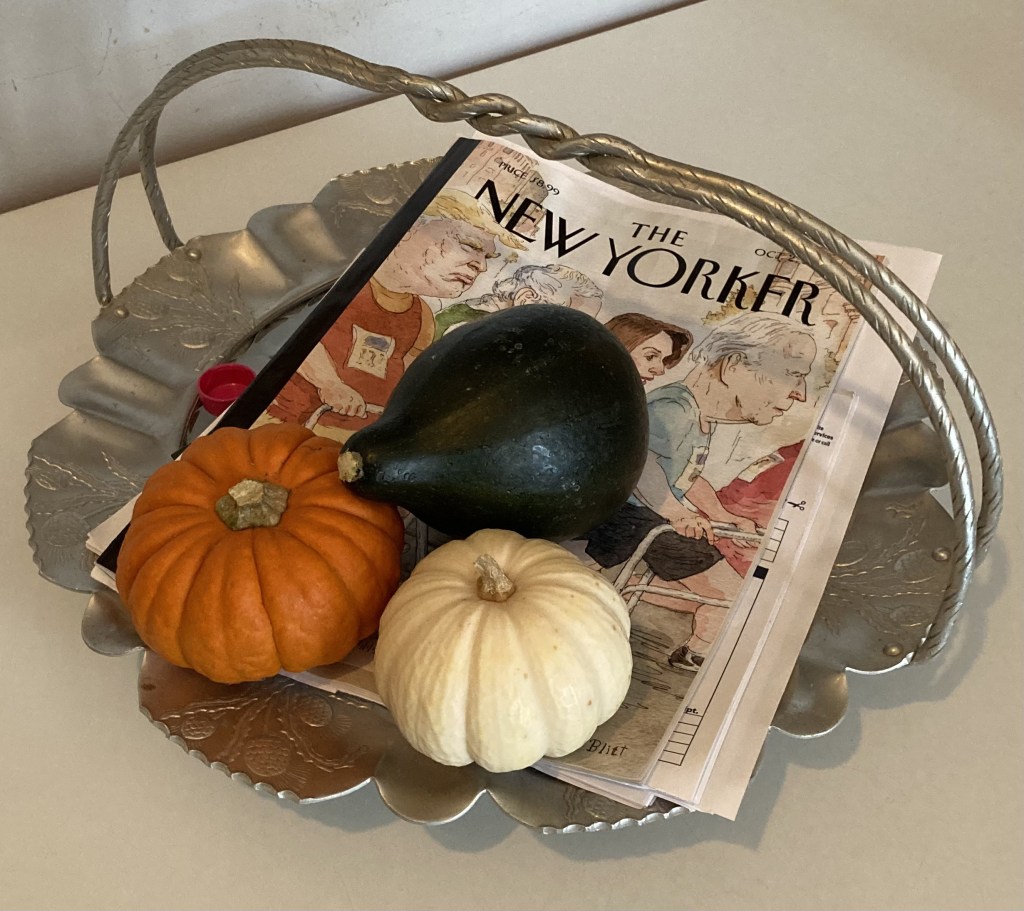
I bought gourds this morning at Trader Joe’s. You know, the Fall/Autumn/Halloween gourds that come out on October 1st, and are sold through Thanksgiving. Well, it was two tiny pumpkins and a gourd to be exact, but as I get deeper into the season, I will buy more of these. I wouldn’t call it a weakness, but it is the one seasonal decoration that I indulge.
Soon, most likely this weekend, we’ll go to our storage space and get the box of Halloween and Thanksgiving decorations to put up. Most of what is in there are silly, kid-like things to put up. Also in that box, there is a collection of dollar store small glittery pumpkins. Soon our kitchen table will be a collection of both real and fake gourds. You know, how the Pilgrims intended.
When the kid was little, two or three, she would paint the white pumpkins to add to the decorations. I don’t think she does that anymore. And I start to wonder how long we’ll keep decorating the apartment with these cartoonish and child-like decorations?
My parents kept reusing all the old holiday decorations until I went away to college. With me, the final child was out of the house, so my mom decided that it was time to have more grown up decorations for all the holidays. Gone were the doe-eyed cats and bats, to be replaced with wreaths of fake orange leaves and gourds. (But her gourds were plastic and ceramic.) Christmas even got more mature with an all-white lights on an all-white tree. You get the idea…
I have a feeling we’ll do the same thing when our kid heads out of here, to college or where ever.
Oh, lord in heaven… we did not sleep last night in our home.
The kid had sleeping issues, and it was difficult for her to fall asleep. Every half hour she was up, and it went on until 1am. This doesn’t happen very often, as the kid is a great sleeper. She always has been. Even as a baby, once you put her down, she was out. In fact, we stopped telling other parents about how well our daughter slept because we could just feel the red-hot hatred and contempt that would get shot at us from our sleep deprived friends.
But this was hard. I think a little of it had to do with the Sunday Night Blues, and not wanting to go to school after a fun weekend. Also, I think she got a little too wound up after dinner with TV, and video games. Normally we turn screens off a half hour before bed, but we slipped up as parents. And once the kid starts having difficulty sleeping, it’s like a self-fulfilling prophecy. She gets so worked up that she’s not falling asleep right away that she starts worrying that she’ll never fall asleep.
What we were left with was a family all worn out in the morning, but we powered through it.
For me and the wife, who seemed to have lived most of our life without enough sleep, it just felt par for the course.
But, oh, the kid… poor kid. This was a special kind of awful that she wasn’t sure how to deal with. She was quiet, this morning, but she got up, ate breakfast, and got ready. We left on time, and made it to school early, in fact. But, it was her being quiet the whole time which was the tell that she was not having any of this.
I wish I could tell her that life as a grown up isn’t normally like this, but this is what life as a grown up is like. You never get enough sleep.
And when you do sleep, you wake up early for no reason at all.
I found this on Twitter/X this morning showing a bus in Brooklyn. I was out doing the Alt Parking at 8:30am and the water was coming up over the curb. This is a lot of rain. Like Texas flood kind’a rain. And last weekend we had the remnants of that tropical storm sit on top of the City for three days and dump loads of rain. Up where we live in Harlem, I don’t think about it flooding as compared to Lower Manhattan, which doesn’t take much submerge that part of the City. But it just won’t stop.
Taking the kid to school this morning meant that we had to trudge out in the rain. We had on rain boots, and rain coats, with umbrellas over the top of us. Not that any of this gear stop us from getting wet, but it wasn’t that bad. And what made it a fun walk to school was the numerous amount of puddles along the way. Which, when you are wet already, what’s the harm of slashing in a puddle or two. And there is something deeply innocent and extremely satisfying in stomping through a puddle. It never is not fun. It is an act that serves no purpose other than making you happy, and identifying people who are sticks-in-the-mud.
The North London Derby ended in a draw. From my totally biased Tottenham Hotspur point of view – it was just as good as a win.
And, I started making a playlist for when I am at the gym. It’s nothing but disco music, but specifically, the disco music I remember hearing as a kid. And as I am compiling this list, I can’t shake the feeling that this music is sweaty. Like it conjures up the feeling of being hot and sweaty on a dance floor – in the Summer. And it’s not an image I get in my mind, but a feeling, a sensation of being on polyester and dancing.