(The short story “Wall Cano” by Souvankham Thammavongsa appeared in the November 2nd, 2026 issue of The New Yorker.)
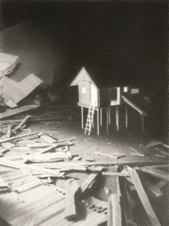
Illustration by Lewis Chamberlain
The first school science fair I participated in was six grade, and the kid that won the fair built a working model of a volcano. He had the whole baking soda and vinegar eruption that came overflowing out of the top of his mountain, which was so well done, we all assumed that his father had helped. To this day, when the words “science fair” are spoken, my memory goes back to that volcano, and the intertwined feeling of awe and disappointment. Memory is funny like that, because as an adult looking back, I can see now that I was lazy, and didn’t take the time on the project, and maybe the kid who won actually earned the top prize. Souvankham Thammavongsa’s “Wall Cano” is a story that also has a volcano from a science fair in it, but uses this prop in a very ingenious way, which addresses memory, childhood, and parenting.
The story is about more than a science fair, or even a volcano. Even though the protagonist is remembering her childhood, its presented not as the past in retrospect, but more like a living memory. Tangents and incidents are remembered, not so much as to move the plot forward, more to decorate and color this world that the story takes place in. Not everything is explained, nor is every motivation understood, because this world is remembered from a ten-year old’s perspective. This creates a feeling of innocence in the story; a touch of curious wonder, but not confusion. The protagonist and the younger brother work to understand their world, as their parents aren’t guiding them. This is not due to neglect, but being that the parents are immigrants, the father refers to himself as a refugee, so they aren’t accustomed to how some thing work. And by proxy, neither do the children.
I’m leaving out details of the story on purpose. A little bit because I don’t want to spoil it, but also because what is revealed, and how it is revealed, is an important part of this narrative. What seems random in fact is building the protagonist’s budding cognoscente reality. She might not understand how these things are connected, but she knows they are connected, yet we can see that they are connected. I loved that Thammavongsa trusted us, the reader, that we’d put it all together for the narrative to work, but still left it vague enough so there was a feeling of mystery.
The final section of the story wraps everything up very well; asking how memories stay with us, continue to live in our consciousness, and influence us. And also, leading us to wonder how things would have been different if there was just the slightest bit of change, or even guidance.
