(The short story “Standings” by Chang-rae Lee appeared in the May 11th & 18th, 2026 issue of The New Yorker.)
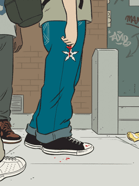
Illustration by Adrian Tomine
When I graduated high school, my uncle got me a subscription to The New Yorker. He was a very smart and well-read man, and he knew of my ambitions to have a writing career, and this graduation gift, which I emphatically received with much excitement, was his way of encouraging me. I say all of this because off and on over my adult life, I have continued to subscribe to The New Yorker, and for that reason I feel fully justified, due to my extensive financial investment in the publication, to complain to the Fiction Department, and formally request they stop publishing works of short fiction which are merely excerpts from novels. I speak of Chang-rae Lee’s “Standings”, which by the magazine’s own admission “… is drawn from “A Tender Age.”” Then adds Change-rae Lee “…is the author of the novel “A Tender Age.” (August, 2026)” Though this work is an excerpt, it was published in the short fiction section of the magazine, so I will be reviewing it as a short story.
“Standings” is the type of story that suffers from the sins of being too smart for its own good, and wanting to do too much. The story is overly long, bringing in as many details as possible to give the reader the full feeling and experience of what it was like to grow up in this environment of 1976 adolescence. Not to make light of the subject matter, but this is a coming of age story of boys on the cusp of crossing into adulthood, and being unclear what to do with the rage and aggressiveness they are supposed to embrace as they try to figure out what manhood is. This is a pack of “lost boys” with no direct positive male influence, and left to their own devices, devolve into racism and violence. On the surface, this is a deep well to work with, and speaks to the potential of an engaging and enlightening story. But here, the story felt unfocused on what it truly wanted to tell, with many tangents of ideas flailing. As Milhouse would say, “When are they going to get to the fireworks factory?!”
Another issue that I had here was that I never felt the protagonist was ever in any peril through the course of the story. I spoke of the aggression between the boys, but the tone flipped between a comical story of boys posturing toward each other knowing that nothing would happen, to a very serious they must kill or be killed. Instead of creating a logically narrative development, such as playing at being violent leading to violence as survival, the story seemed to flip a switch. What we are given is a bipolar feeling of it just “happens,” which left me thinking I had missed a step, or an unearned short cut was taken. By doing that, the intention of the action never felt believable. The protagonist does pull out a knife at school and tries to harm another student, yet his consequences are suspension, some therapy, a bit of social ostracization, but on the whole he was able to continue on as a well-adjusted adult. Meanwhile the other boy has trouble coming out of his home due to the trauma, and another boy turns out was schizophrenic all along. Other than that…
This brings me to my last point, which is that I never felt an urgency in the writing. In my point above, I stated that the protagonist never felt in peril, and part of that has to do with the language used. The narrator/protagonist is clearly writing this story – this is a first-person narrative that would never be confused with a friend talking to us, or a person at a bar telling us this story. No, this is unquestionably a story being written, and as such, it sticks to the rules. (Hell, the knife was introduced in the second act, and was used in the third.) It felt like an undergrad working hard to get an A in a creative writing class. The narrative plays it safe and does everything right, but in so doing, it never takes a risk or displays an intensity. The thought that I had reading this was maybe you can be simplistic and minimal.
“Standings” doesn’t work as a short story, but I also admit I don’t think it was ever meant to. For all I know, “A Tender Age” could be a great book, and given the breath and space that a novel can take, perhaps all of these pieces tie together and it plays like a fine-tuned song. But in the end, this just hammers home to me that not every story should be a short story.

