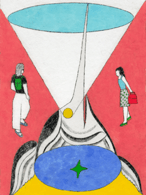
The “Door in the Woods” by Chris Scott pulls off my favorite story telling trick; It leaves me with more questions than answers, but not in the frustrating “jerk you around” kind’a way. This is a work that straddles realism and surrealism. It is relatable, authentic, but also funny and absurd. In little over 1,100 words, it is a very specific story addressing a rather universal experience most encounter in their relationships.
The story starts off with a bit of mystery and tension. It isn’t until the third sentence wherein the door is identified. Even in the second paragraph, when more of a description of the door is given, there hangs in the air a feeling that the door is unnatural in origin. Then to add to the tension, it is shared that this couple has been in therapy in an attempt to save their marriage. Once they decide how to pass by/through the door, and do so, the uneasiness of the situation fades, and seems to be setting up a metaphor for the couples’ relationship. But there’s a complications; each person remembers the encounter with the door differently.
Was this a supernatural encounter? Is this couple like every couple, and having a moment where they remember things differently? Is the door affecting their ability to remember? Or is this misremembering an act of sabotage by one of the partners? These questions hang, and motivate the narrator, who is the husband in the couple. Truth isn’t the goal, when an answer, a conclusion, or closure is what’s needed.
Scott does an excellent job creating tension, unease, and relatability in this work. The husband’s need and search for an answer from this unusual event underscores his desire to create stability and peace in this rocky marriage. I don’t know a single person who hasn’t agreed to a lie to keep a fight from bubbling up in their relationship. In this story, you can feel the eggshells the husband stands on, and the fear that this could be the event to push this marriage over the edge.
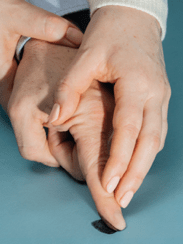
(The short story “Intimacy” by Ayşegül Savaş appeared in the October 20th, 2025 issue of The New Yorker.)
Photograph by Elinor Carucci
“Intimacy” by Ayşegül Savaş has been sitting with me for a couple of days now. I’ve read it three times, and I am still mulling over the construction of it, the theme, the use of language, and the lack of it as well. I keep thinking that there is a simplicity to this story, but that is just an illusion to its complexity. I want to believe that I would never behave like the protagonist, but honestly, I completely behave like the protagonist. Savaş uses the normal short story tricks; foreshadowing in the first paragraph, use of the rule of three, and uses the death of a character as the climax. But Savaş uses these tricks, and a few others, is such ingenious ways, that this story feels fresh, and left me wondering, and I mean this in an intriguing positive way, what is going to happen next?
To describe the plot I feel is rather a meaningless exercise as it won’t get to the heart of what makes this a compelling story. Here goes anyway: In an unnamed city, there is a group of expats from an unnamed country. The groups tries to support each other in adjusting to life in this new city, and to that end our narrator, who is a published writer, is connected with an older and very successful writer from the same expat group. They have lunch together. The lunch goes well, and eventually the older writer brings his wife to a lunch and the narrator and wife hit it off. Then the narrator and the wife go out and have a picnic together which also goes well, but the narrator drops returning text messages from the wife. One reason is that the narrator’s very young daughter breaks her clavicle. Through a dinner party later in the story, the narrator learns that the writers wife is ill. And maybe that’s a good place to stop.
Through the story I kept wrestling with what to make of the narrator. On one hand, I was perplexed by some of her decisions, but on the other hand, I had to admit I have made the same choices that she does. Such as when talking to the writer about traveling back to their home country, she omits telling him how her children cried and complained wherever they went, but made it sound like the trip was ideal. Not exactly a lie, but also not the truth. In another example, she doesn’t inform the daycare of her child’s fussiness which could help explain when the kid’s accident occurred. Her reasons for the omissions are understandable, but in another light of perspective, she could be viewed as manipulative. These are but two examples the narrator makes that left me with a feeling of ambiguity, which played well into the theme of this story.
Then there was the use of language. As I alluded to before in the description, virtually everything is left unnamed. No cities, countries, locations, and especially proper names. Only two are used, and they are deliver deliberately to have the perfect impact on the story. Not only do the name reveals play into the theme of intimacy, but it also ties back into the motivations of the narrator. Why does she choose to reveal them at that time and in that manner? Furthermore, the language is smart, direct, cutting, but also vacant and void of a deeper meaning or connection. The narrator’s word choice appears to be open, but they are a defense, keeping people away.
Through all of this, I have been chewing on the theme of “Intimacy.” What is Savaş trying to say about how people open up, and close themselves off? The narrator mentions a husband, and how they cooperate to take care of their children, and work, but she never shares any feelings about him. It’s never expressed that there is an issue between them, but then why is his name never shared with us? Most importantly, the wife of the writer makes efforts to connect with the narrator, which the narrator ignores. The narrator only changes her attitude when she find out the wife is ill. A rather shallow reaction, made worse by the narrator using her daughter’s injury as the explanation/excuse for the ghosting. Most people share themselves to form connections, but do some people share out of guilt? Sharing enough to stay relevant while still distant?
“Intimacy” is my favorite type of story; one that I read over and over to discover more details and motivations, which enriches the story further. I keep thinking that I should be annoyed and disappointed with the narrator but I find her failings makes this character all the more human and believable. This story wonderfully confounds me. But so do most of the people I love. And they might say the same thing about me.
I like being a dad. Fatherhood has been more rewarding than I imagined. And I will also say that parenting is harder than I thought possible because unforeseen changes seem to happen every three months. Just when I think I got it down, life with the kid takes a right turn. Though me and the wife had plans and best intentions, we learned that we weren’t in control. Reading Emily Rinkema’s cute and humorous “13.1 Septillion Pounds,” I was reminded of all of those emotions, especially when our kid was still a squirmy baby.
The premise of the story is that two parents go to wake their baby only to find that the child has written math formulas and equations on the walls the night before. The math is accurate, as two mathematicians arrive and verify. I feared this setup was going to lead to a one-note joke; kid does something crazy therefore the parents have a crazy reaction.
I needn’t have worried.
What the story is playing on is the unintended consequences of the parents’ well intended actions. Perhaps the Grandma was correct and the child is just gifted, and this situation would have come about inevitably. Or, maybe it was the mobile displaying the galaxy that influenced the baby? Clearly the basketball that the father left in the crib helped the child formulate the weight of Earth. Though I’m not sure I know a parent that would leave a Sharpie in their child’s crib, but hey, I can let that one go. The truth, and the humor for that matter, of this story lies in an honest fear and hope that parents have; they hope their children will do better than them, but fear that in succeeding the child will become someone they won’t understand.
The conclusion that the parents reach is correct, and one which makes the world right again. It is wholesome, right and honest, all the things that I hope parenting is. Most of the time, I have no idea what I am doing as a father. It’s a scary tough job. But being able to help my kid become who they are is a deep and profound privilege. It’s just a really bumpy ride that loves to make a bunch of turns.
I had the hardest time coming up with a solid opening paragraph for this review of Kara Melissa’s non-fiction piece “They Only Come Out at Night.” I like to think that I’m good at introductions, but not this time. The issue I am having is how I can’t wrap my arms around this essay to find one single starting point to explain how this honest, interwoven, melancholic story affected me.
From the first paragraph, Melissa pulled me in with an intense honesty; confidant in its story telling. Not for shock value, nor did this feel like oversharing, or a performative confession. This was a clear declaration of deep emotions, fully self-aware that maybe some people wouldn’t understand this situation, but it was true.
What follows are three tangents, platted together with connecting themes of MRI’s, hospitals, logic, brain function, and most importantly love; the compassion, empathy and longings which form in situations Melissa finds herself in. Through all of it, I felt this wrap of a happy melancholy resignation to it all. I wish I could explain that better, but it’s what I feel someone who has loved deeply, and lost greatly would feel towards the world.
I relished how the essay is presented straight forward and logical – The descriptions of medical treatments, aliments, and the causes. The setting is during the Covid lockdowns, and with the clinical narrative, Melissa creates a feeling of isolation and detachment. This makes her desire for connection, understanding, and compassion all the more pertinent.
I don’t want to belabor this review, as I am purposefully not going into all the details of the essay, because you should go read it. But I will say that the last section left me with a wonderful feeling of hopefulness. That even in the darkness, when we feel lost, that the love we have for each other can carry us through. With everything going on, I needed to be reminded of that fact.
(The short story “Unreasonable” by Rivka Galchen appeared in the September 29th, 2025 issue of The New Yorker.)
Photo illustration by Stephen Doyle
A couple of years ago, my daughter got invited to a classmate’s birthday party, and as good parents, we attended with her. As the wife and I mingled with the other parents hiding on the periphery of the party, we struck up a conversation with a father who was a scientific researcher on fruit flies. It took a few minutes to convince him that we were actually interested in what he did, because as he put it, “No one thinks fruit flies are interesting.” But once he started talking about his research, he got excited and animated about the topic. It was a great conversation, and it reminded me that if someone is passionate about what they do, when they talk about it, it can be very interesting.
It was this conversation that I kept thinking about as I read Rivka Galchen’s “Unreasonable.” The narrator/protagonist of this story is a bee researcher at a university, and in essence, she’s telling us about her life and about bees. These two tangents work exceedingly well at complementing each other as the narrator’s tone is measured, funny, scientific, and relatable. I was struck at how seamless the story went from one area to the other, exemplifying how much the research and her life were intertwined, and impossible to separate from each other. But what truly reminded me about the conversation at the birthday party was how excited and passionate the narrator was about bees. Maybe it wasn’t a volcano of exuberance, but it was an intense interest and knowledgebase, just like that fruit fly researcher. Their excitement, made you excited. I don’t know if Galchen is a bee enthusiast or not, but if she isn’t, then lots of respect to her for creating this character.
The other aspect of “Unreasonable” that I enjoyed was how the narrator, perhaps a bit subconsciously, viewed her life through the lens of bee behavior, and the study of bees. It’s pointed out in the story that male bees only have one function in the hive, fertilization, and that they don’t do anything else. I couldn’t help noticing that this fact of male bees is used almost like a prism towards the other male characters, exemplifying how some of them shirk responsibility, are adolescent, or are oblivious to the world around them. Then there is the use of tracking bees in the narrator’s research, and also how tracking is used in her personal life; how she tracks one of her daughter’s movements on an iPad, and how the other daughter used a bee tracking device to follow an ex-boyfriend. There are other examples in the story, but I think you get the point. It almost felt like a fun parlor game connecting the two worlds together.
I liked “Unreasonable” and enjoyed how this was the type of story that kept rolling and moving, and left me wondering where it was going, but was happy to have that feeling of unexpected surprise. This was a fun place to inhabit with the narrator, and experience her world, because it’s exciting to be around a person who is excited about what excites them, and let’s it swarm into their life.