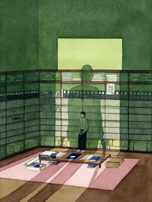
“The Honest Island” by Greg Jackson revolves around, and functions off of, the idea that the protagonist, Craint, finds himself on an island, but he can’t remember how he got there, or why he is there, or pretty much anything else. It’s a good type of mystery to start a story off with. In case you don’t know, “craint” also happens to be the French word for “fear.” (Yup, it’s that type of story.)
Craint goes about his business on this small island. Generally, staying at his small B & B, going to the beach, napping, drinking beer at sunset, and contemplating why he can’t remember anything. Yet this doesn’t bother him too much. Though he can’t speak the local language, he has found ways to get by, and even has met a woman whom he occasionally dines with, but nothing much happens with her. Craint can see across the harbor, where a city looms, so he knows he’s not completely cut off from the world, but at the same time, he cannot seem to find the ferry to take him off the island. Then along comes a new person, a man named Budger, who also is confused as to why he is there, and persuades Craint to show him around the island. FYI: “budger” is an English word from the early 1600, which means a person who stirs or budges. (See, that type of story.)
It’s not a bad story, it’s okay, but at certain moments, it can be heavy handed. (Have I mentioned the character’s names?) What works for the story is how the mystery of the piece, the tone, and setting, work very well together. It feels solid, but also like shifting sand under your feet. Jackson didn’t over play that hand, which kept the story compelling and engaging. Where the story lost steam, was the rush to the conclusion. What came before in the story took it’s time, but the ending felt like it was trying to beat the clock and get to the finish line. For that reason, what the conclusion was didn’t feel complete, and in a strange way, predictable.
How does the phrase go; “The unexamined life is not worth living.” At least, that’s the philosophical dictum that has been credited to Socrates. Some days, I think that is the job of a writer; to examine life and make it worth living. That was the mind space I was put in when I finished reading “From the Wilderness” by Yukio Mishima.
Here’s my overly simplified synopsis: A mental unbalanced youth breaks into the home of the author, which causes the author to contemplate life and loneliness.
Couple of things here. I appreciated the structure of this piece. The first part was from the author’s point of view of the incident. Then the second part was an overall description of the entire incident, showing how the other people in the home reacted. Then the final part was the author contemplating the event, trying to make sense out of it. In this structure, the narrative of the event goes from very narrow, to expanding to a wider view of the many people in the home, and finally taking in the world of the intruder, and the larger world in general. In this way, the narrator goes through a progression of expansions, which leads to the author having a new understanding of the world he lives in, and creating a feeling that a journey has commenced.
But what I enjoyed most was that this was a story that took its time. Mishima was patient with his storytelling, letting the ideas of loneliness evolve and develop, which had a natural and authentic feeling to it. I know this is a work of fiction, but with the narrator also having the same name as the author, it creates a conundrum of how much of this is fiction, or reality? Sure, it’s a device, but played well here as it lends itself to give a legitimacy to the thoughts and conclusions.
They don’t make stories like this anymore. Short fiction that enjoys language (Bonus points to this translation,) playing with language, and isn’t afraid to take time, but not waste our time. Maybe this wasn’t the most profound story I have read recently, but Yukio Mishima reminded me that life is meant to be examined.
(The short story “War Dogs” by Paul Yoon appeared in the October 28th, 2024 issue of The New Yorker.)
Illustration by Wesley Allsbrook
I had no idea that airports have animal centers. I feel like I should have known this before, I mean, with all the time I have spent at airports and seeing all the animals that come through there, it seem obvious now. It must be such a mystifying experience for animals to be loaded on a plane, taken to some place new, and how their heightened senses discover that new place.
If you couldn’t guess, Paul Yoon’s short story “War Dogs” takes place at an animal center at one of New York City’s airports. It is an intertwined story of animal caretakers, a veterinarian, a mother traveling to Korea, a brother and sister set of dogs from Afghanistan, and a horse. Some of these characters ran from destructive situations to start better lives, some are pulled back into their old world, some are physically changing which causes them fear, while others want the comfort of those they love.
The story was structured in eight sections, or vignettes. Each sharing insights and developments with the characters. It was a practical form to use for this story, as Yoon’s storytelling was well balanced, so we never dwelled too long on one particular plot line. It reminded me of jazz, with the theme acting as the rhythm of the piece, with each character getting a solo. This allowed each character to get fleshed out, giving some depth, and I am being vague on poupose to not spoil this story.
Yet, I couldn’t shake the feeling that it didn’t wrap everything up as it should have. What this piece felt like was the first chapter of a novel; characters are being introduced, goals are set, complications develop, questions are raised. But not everything is concluded, leaving many questions left in the air. In this state, I was left feeling stood up, and incomplete.
I understand the old adage that a writer should leave the reader wanting more, but in this case I want a novel about this place, the animals, and the people. I don’t need to tell you Paul Yoon is a good writer; read this and you’ll see. And if this was the first chapter of that novel, then I bet it would be great.
(The short story “My Camp” by Joshua Cohen appeared in the October 21st, 2024 issue of The New Yorker.)
Photograph by Naila Ruechel for The New Yorker
So… What to make of “My Camp?” I guess I could say that Joshua Cohen wrote a story that I had no idea where it was going. That was refreshing. After that, I’m not sure what to think. I know I didn’t hate this story. It was a bit long; it did go on, and could have used some trimming. But, I’m just not sure…
It started out well; lulled me into thinking this was going to be a comedic take on upstate home ownership. Then, Cohen threw a curveball, which had the story move in an altogether different direction, only to come back to the camp at the end. I’m not even sure the narrator learned or changed an any way, which normally would cause me to pan the story, but in this piece, that might have been the point?
What I identified with was the narrator’s frustration with there not being a middle ground when it comes to October 7th, and the Gaza war. How people want the narrator to take a side, and the more pressure that is put on him, the more he digs in to not take a side. How if everyone is blindly going in one direction, you should go the opposite way. That resonated, especially in light of current events in the Mid-East.
But I still couldn’t tell if this piece was satire, a pointed take on conviction in light of what is happening, or was this just supposed to be a joke? I would hate to think that I am clutching my pearls here, thinking it’s too soon to even remotely make any artistic comment on Gaza, as I believe one of the main reason to have art is to comment on difficult issues. Yet, wasn’t this just a story about a guy that got comfortable with scamming people so he could own a home?
There isn’t a clear easy answer to this story, which I feel was Cohen’s point. Were people really trying to help? Does throwing money at a problem fix anything? Is greed inevitable? Is there no safety in the world and you have to take it when you get it? I could go on and on with all the questions this story brought up in me, and perhaps I should read it again. Though I don’t think that will help me find any answers. Anyway, maybe that’s just human nature – looking for answers.
I’m open to hearing what other people think on this one. Drop a comment, let me know what you think about this story.
(The short story “Hi Daddy” by Matthew Klam appeared in the October 14th, 2024 issue of The New Yorker.)
Photograph by Ryan Lowry for The New Yorker
As I get older, I have this dualistic thought in my head when I think of my parents; How much I am like them, and how much I am not like them. This dualism can cause great joy, and unbelievable anxiety in me. I also know as a middle-aged man, that the more things change, the more they stay the same. With Matthew Klam’s story “Hi Daddy,” a well-intended but uneven work, he attempts to address these issues.
Here’s my way to simple synopsis: Middle aged man says goodbye to his teenage daughter as she goes off to Europe for the summer before she starts college, and then he visits his elderly parents, realizing that he is more like his father than he wants to admit.
Emotionally, I dug this story, and identified strongly with the narrator. There was an honesty in the narrator, that sometimes got very close to self-pity and whining, but Klam was able to pull it back in time. The narrator, in his family, has the role of primary care giver, as his wife has the job that earns the majority of their living. This role has left the narrator feeling taken for granted and left out, though his wife does point out that he is the cause of this situation, as he can be emotionally unavailable, especially to their daughter. Part of his issue stems from having trouble dealing with his daughter leaving home, and the changes that it will bring. When he visits his parents, his father has fallen and has dementia. The dementia means the father no longer recognizes the son, and the fall means that the once stoic and distant father has become feeble and dependent. Again, the theme of change, and the act of dealing with change, gives the story a weight here, and the narrator’s inability to know how to deal with these situations and emotions has a melancholic honesty to it.
Yet, I had issues with this story, and they were all technical storytelling issues. When I finished the piece, I was left feeling unsatisfied, and that was due to none of the story threads felt wrapped up. Many emotional tangents are cast about in this story, but they don’t come back or lead to a resolution. The narrator says that he doesn’t like his parents, but the issues are with his father, so why is the mother put in the same bucket with the father? When the narrator realizes that he is becoming like his father, will that influence future actions of the narrator?
That last one was the kicker for me, for that was the driver for the unsatisfying feeling the story created in me.
If this is a normal “Hero’s Journey” story, then the narrator’s realization that he is like his father would then influence an action in the climax of the story, therefore allowing the hero to defeat the obstacle and view the world in a different way. The best that I can tell, the hero’s obstacle is himself, the climax has to do with the horse getting free (horse also metaphor for father/son,) yet the narrator’s actions in dealing with the horse are not influenced by his realization. If this is a normal “Rising Action, Climax, Resolution” story, then I’m not sure what to make out of the last two sections as a resolution; the thoughts the narrator has about his daughter’s choice in boyfriends and her actions towards them, and final section which is a “Dead Chick in the Basket*” cliché. That left me to believe that this whole exercise was just a meditation on the narrator dealing with a rough two days, and the narrator is the same person at the start of the story as he is at the end of the story. And if that is true, the narrator doesn’t change, then why are we being told this story?
I will say this, “Hi Daddy” has some very fine points, and some crisp, honesty imagery and writing. Matthew Klam is writing about a character who is flawed, which is just ripe for storytelling. And it almost gets there. He just didn’t stick the landing.
* “Dead Chick in the Basket” refers to a writing device where the final paragraph of a short story contains new information about a character which is meant to make the reader view the actions, statements, or feelings of that character in a different light. The first known use of this device was in J.D. Salinger’s short story “Just Before the War with the Eskimos.”