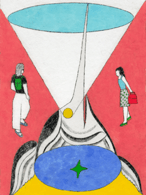
(The flash fiction story “Bed Rot” by Sarah Chin first appeared on November 14, 2025 at Okay Donkey.)
If you read enough flash fiction like I do, you notice that a couple of subjects are rather popular with writers; death, pets, and breakups. This isn’t a complaint, as I understand why – the three I named bring up strong emotions in people. Breakups are an especially tricky one, as the writer has to thread a very fine needle – don’t want to be too angry and come across as bitter, and god help you if you are too whinny. The best breakup pieces, I find, work in a healthy amount of humor to balance their pathos, which is why Sarah Chin’s “Bed Rot” is such a fun and honest work.
You can never go wrong with a good opening line, and here Chin delivers a sentence that at first hints at a promise of possibility only to end with the foreshadowing of what is actually to come. Word choice, and sentence length is used here to create a staccato rhythm that keeps the piece moving in spurts and prolonged moments. This creates a feeling that nothing is centered or even fully processed; that what the speaker is experiencing still has a level of shock to it, but also balanced with a desire to try and stay in control of their emotions.
Another aspect of the piece I enjoyed was following the path of thoughts the speaker has, and the logic it traverses going from subject to subject. From tulips, to the other woman’s name being Amsterdam, Martha Stewart’s idea of women and flowers, from the shedding of the brunch date outfit to be comfortable, and a little tulip madness thrown in. Peppered in each subject are dry comments, and observations that are sharp-tinted with a hint of anger, but tempered with humor. Nothing spins out of control, though it feels like it could, yet never does.
“Bed Rot” does stick to a structure which dramatically works very well. Each subject change, and snarky comment is building toward the climax of the speaker expelling this relationship and its confinement to her. What she is left with is a raw, more authentic self, thus completing this journey, and leaving us with the understanding that she will continue to grow and be fine.
(The short story “Safety” by Joan Silber appeared in the December 8th, 2025 issue of The New Yorker.)
Illustration by Chris W. Kim
You know, every “time” is a “historic time” but some are more historic than others. I will agree that we are in the middle of one of those historic times, and if I am lucky enough to have grandkids, then I imagine they will ask me “WTF was everyone thinking, grandpa?” The good news is that over the past three or four months, I have started to see works of art in different media start to tackle the events of deportation, disappearing, and what effect these policies will have on America. I am going to throw Joan Silber’s “Safety” in with all of these works, though uneven, I applaud what this story attempted.
Overly Simplified Synopsis: Two girls become friends growing up in New York, one Muslim the other Jewish, and both decedents of people who immigrated to the US to escape dictators. They go their separate ways in life and reconnect in New York, where the Muslim friend now has a child and a partner who is a comedian. When the comedian is on his way home from a gig, he is disappeared by the Administration.
There is an ease to this story, and a simple directness to the writing. What it does well is create a picture of the modern melting pot that America is – people of different backgrounds are still coming here, and their children are still connecting with people that are different from them, and finding a commonality in our shared humanity. Silber does well in creating a context for the Muslim family regarding escaping the Nazis, being forced to migrate by Stalin to Uzbekistan, and the trauma of family separation.
Yet, through it all, I couldn’t shake the feeling that this story was pulling its punches. There is a huge amount of drama here that is being sieved through a philosophical existential filter, but it never seems to amount to an emotional climax. For example, think of how these families lives’ have been influenced by authoritarians – from being pushed out of home nations, to being pushed together in America – and how these families have made new lives for themselves. And when a new Authoritarian pressure is applied, the characters seem more resigned, as if ordained to this fate, rather than free to exist.
Ultimately, I appreciated this story, and Silber, for taking a swing at an issue that needs to be swung at. “Safety” uncomfortably reminds us that history does repeat itself. That immigration, deportation, and citizenship (both in its legal and the social definition) needs to be discussed and debated again, so we can finally find a way to break this awful cycle.
(The short story “Mother of Men” by Lauren Groff appeared in the November 10th, 2025 issue of The New Yorker.)
Photograph by Bryan Schutmaat
“Mother of Men” by Lauren Groff is a good story, except for one thing. And I’ll get to that.
But before I get to that, this story made me think about the world my mother lived in. She was married with three sons, and though she told us she loved it, she did have to deal with three stinky boys, who became men, and all the baggage that came with it. Later in life, when me and my brothers got married and had our own families, did it start to dawn on us how much of her life was confined with masculine demands. In that context, much of what is expressed in this story by the narrator rang true to me; that men are always in her house, how her boys were now men, and the need for her home to be a safe place.
When the stalker is added to the story, and thus kicking off the plot, the menace that this man places on the narrator, is not only an immediate threat to her, but also to her home, and these men in her life. And this stalker is truly a threat, because he does have a gun. This weapon also functions as a reminder that violence and men are never too far apart from each other. Her husband has a baseball bat, her sons offer their own cocky protection to their mother, and the narrator even tries to enlist the workers from her home renovation for additional security. All of this raised interesting questions of violence and safety, of masculine and feminine roles, how a mother goes from protector of her sons, to needing protection from them. Even the title of story, which is also the title Catholics use in reference to Mary mother of Jesus, wasn’t lost on me, and added another layer to the piece. Great stuff.
And then the climax happened. The stalker enters the home at night, the narrator is unable to take action, so her son asks the stalker to leave, which the stalker does. And it felt completely incongruent to everything that had come before in the story. This climax broke Chekhov’s Gun Rule, which means if you introduce a gun in the story, you have to fire it at the end. There was an expectation of violence, threat, even menace in this story, and to not deliver a resolution to that expectation left the ending of the story feeling hollow. And I did spend time thinking about this climax and the choices that were made, but I kept coming back to the same conclusion – the gun needed to be fired.
The “Door in the Woods” by Chris Scott pulls off my favorite story telling trick; It leaves me with more questions than answers, but not in the frustrating “jerk you around” kind’a way. This is a work that straddles realism and surrealism. It is relatable, authentic, but also funny and absurd. In little over 1,100 words, it is a very specific story addressing a rather universal experience most encounter in their relationships.
The story starts off with a bit of mystery and tension. It isn’t until the third sentence wherein the door is identified. Even in the second paragraph, when more of a description of the door is given, there hangs in the air a feeling that the door is unnatural in origin. Then to add to the tension, it is shared that this couple has been in therapy in an attempt to save their marriage. Once they decide how to pass by/through the door, and do so, the uneasiness of the situation fades, and seems to be setting up a metaphor for the couples’ relationship. But there’s a complications; each person remembers the encounter with the door differently.
Was this a supernatural encounter? Is this couple like every couple, and having a moment where they remember things differently? Is the door affecting their ability to remember? Or is this misremembering an act of sabotage by one of the partners? These questions hang, and motivate the narrator, who is the husband in the couple. Truth isn’t the goal, when an answer, a conclusion, or closure is what’s needed.
Scott does an excellent job creating tension, unease, and relatability in this work. The husband’s need and search for an answer from this unusual event underscores his desire to create stability and peace in this rocky marriage. I don’t know a single person who hasn’t agreed to a lie to keep a fight from bubbling up in their relationship. In this story, you can feel the eggshells the husband stands on, and the fear that this could be the event to push this marriage over the edge.
(The short story “Intimacy” by Ayşegül Savaş appeared in the October 20th, 2025 issue of The New Yorker.)
Photograph by Elinor Carucci
“Intimacy” by Ayşegül Savaş has been sitting with me for a couple of days now. I’ve read it three times, and I am still mulling over the construction of it, the theme, the use of language, and the lack of it as well. I keep thinking that there is a simplicity to this story, but that is just an illusion to its complexity. I want to believe that I would never behave like the protagonist, but honestly, I completely behave like the protagonist. Savaş uses the normal short story tricks; foreshadowing in the first paragraph, use of the rule of three, and uses the death of a character as the climax. But Savaş uses these tricks, and a few others, is such ingenious ways, that this story feels fresh, and left me wondering, and I mean this in an intriguing positive way, what is going to happen next?
To describe the plot I feel is rather a meaningless exercise as it won’t get to the heart of what makes this a compelling story. Here goes anyway: In an unnamed city, there is a group of expats from an unnamed country. The groups tries to support each other in adjusting to life in this new city, and to that end our narrator, who is a published writer, is connected with an older and very successful writer from the same expat group. They have lunch together. The lunch goes well, and eventually the older writer brings his wife to a lunch and the narrator and wife hit it off. Then the narrator and the wife go out and have a picnic together which also goes well, but the narrator drops returning text messages from the wife. One reason is that the narrator’s very young daughter breaks her clavicle. Through a dinner party later in the story, the narrator learns that the writers wife is ill. And maybe that’s a good place to stop.
Through the story I kept wrestling with what to make of the narrator. On one hand, I was perplexed by some of her decisions, but on the other hand, I had to admit I have made the same choices that she does. Such as when talking to the writer about traveling back to their home country, she omits telling him how her children cried and complained wherever they went, but made it sound like the trip was ideal. Not exactly a lie, but also not the truth. In another example, she doesn’t inform the daycare of her child’s fussiness which could help explain when the kid’s accident occurred. Her reasons for the omissions are understandable, but in another light of perspective, she could be viewed as manipulative. These are but two examples the narrator makes that left me with a feeling of ambiguity, which played well into the theme of this story.
Then there was the use of language. As I alluded to before in the description, virtually everything is left unnamed. No cities, countries, locations, and especially proper names. Only two are used, and they are deliver deliberately to have the perfect impact on the story. Not only do the name reveals play into the theme of intimacy, but it also ties back into the motivations of the narrator. Why does she choose to reveal them at that time and in that manner? Furthermore, the language is smart, direct, cutting, but also vacant and void of a deeper meaning or connection. The narrator’s word choice appears to be open, but they are a defense, keeping people away.
Through all of this, I have been chewing on the theme of “Intimacy.” What is Savaş trying to say about how people open up, and close themselves off? The narrator mentions a husband, and how they cooperate to take care of their children, and work, but she never shares any feelings about him. It’s never expressed that there is an issue between them, but then why is his name never shared with us? Most importantly, the wife of the writer makes efforts to connect with the narrator, which the narrator ignores. The narrator only changes her attitude when she find out the wife is ill. A rather shallow reaction, made worse by the narrator using her daughter’s injury as the explanation/excuse for the ghosting. Most people share themselves to form connections, but do some people share out of guilt? Sharing enough to stay relevant while still distant?
“Intimacy” is my favorite type of story; one that I read over and over to discover more details and motivations, which enriches the story further. I keep thinking that I should be annoyed and disappointed with the narrator but I find her failings makes this character all the more human and believable. This story wonderfully confounds me. But so do most of the people I love. And they might say the same thing about me.