Tag: Short Story Form

  • Short Story Review: “The Narayans” by Akhil Sharma

    (The short story “The Narayans” by Akhil Sharma appeared in the August 26th, 2024 issue of The New Yorker.)

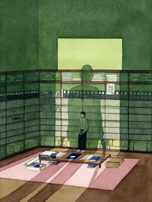
    Illustration by Sargam Gupta

    Gossipy neighbors; We all have them. They seem to live on the edges of most stories, novels, and sitcoms. Sometimes it’s not the neighbors, but the community as a whole that is a gossip. People will talk, and make conclusions, and jump to conclusions. It never works out well. And the neighbors do talk in Akhil Sharma’s “The Narayans,” but the clichés and tropes that usually develop and deftly avoided in this work.

    First of all, Akhil Sharma makes an ingenious choice with the narrative of this story, which sets an impactful tone. The narrator of this story is third person limited, and is also a member of the community from which the story takes place. (Maybe it’s first person limited…) It makes the narrative of the story feel as if it’s second hand, possibly unreliable. Any insight from this story comes from the narrator, and not from any of the other characters.

    The narrator tells us about the Narayan family, who live in an Indian immigrant community in Edison, New Jersey. Mr. Narayan is an unpleasant man, while his wife is overly generous. They have two children, an older son, Vikas, and a younger daughter, Madhu, whom Mr. Narayan is overly protective of. We also meet the neighbors, Dr. Shukla and her daughter, Nehali, who is the same age as Madhu, fourteen. Soon it is discovered that Madhu is pregnant, and at first the rumor is that Vikas is the father. Then the rumor is that Mr. Narayan is the father. Madhu is then sent to India, while Vikas is attacked at school by a pack of white girls. The community turns on the Narayans, wherein Mr. Narayan also returns to India, and receives what the narrator implies is his comeuppance. Then time goes by, and the community changes as a new wave of immigrants from India arrive. Soon notions and stigmas also begin to soften, and Mrs. Narayan is no longer judged in the same way. This leads to the climax of the story, and Madhu’s return to this community in New Jersey.

    This story was a kick to my gut. It completely created a sympathy in me for Madhu, and to be empathetic to her situation. But it also left me feeling conflicted with how the community reacted to this situation. How this community blamed, possibly correctly, one person, while ignoring the victims. The swift kick this story gave me had the effect of making me question my need to assign blame first, and not sympathize and help those that have been hurt. How that lack of sympathy and empathy can add to a person’s trauma.

    As with all stories that deeply affect me, I am having trouble putting my finger on all the aspects and details in this story that give it such a full breath, and life. But, that’s also the sign of a very good writer, and Sharma is that. And still I was left wondering if everything I was told, was in fact, true. That isn’t a knock against this story, just an acknowledgment that the theme and tone were spot on for this piece.

  • Short Story Review: “Smoke” by Nicola Winstanley

    (The short story “Smoke” is part of Nicola Winstanley’s short story collection, which is entitled SMOKE.)

    I took a writing class, long time ago, and the professor pronounced to us on day one, that “Your characters are your babies. And if you want to be a good writer, you have to make your babies suffer.” He was a bit dramatic, but academically, his was correct; characters have to be knocked down to make their eventually rise have any dramatic or cathartic weight. This is not a revolutionary idea, as its just essential to storytelling.

    Nicola Winstanley isn’t afraid to make her characters suffer. In her title story, “Smoke,” she allows the nine-year old Amanda to suffer, but also shows us the suffering of her family, and how each of their own pain affects and inflicts on the others. As the story begins, children are being called home for supper by their mothers, but Amanda’s mother has recently passed away, so no one is calling for her. At home, her older sister Judy, dealing with the loss in her own detached way, instructs Amanda to make herself a dinner of toast, as that is all the food in the house that their father has left for them. They tell themselves that their father is still at work and will be home soon. Eventually, he does come home, but its late, the children should be in bed, and he seems aloof to how to take care of two daughters, let alone himself. What follows is a story about a family dealing with grief, but the focus is on Amanda and her wrestling and discovery of the emotions she is experiencing – as for a nine-year-old, these emotions are just beyond her ability to articulate and understand them, but her feelings are strong enough to engage her to action.

    At times I felt that this story was brutal in its honesty. Amanda at first believes that her mother has just gone away, as if there was a chance for her return, but Amanda’s actions betray this belief of hers. Winstanley marvelously illustrates how Amanda does everything in her power to keep the loneness and the emptiness within her at bay, but Amanda is a child, and handles these complex feelings as a child would – playing with a friend, eating sweets, hiding from her sister, and waiting for her father to return. All for not, as slowly it dawns on Amanda that she is alone.

    The other touch that I enjoyed with this story was how the other two family members dealt with their own grief. Judy’s reaction is to leave this home, and stay with a friend’s family. Maybe Judy is saving herself, finding a way to survive this situation, but to do that she has to abandon her sister. And then there is their father, who’s way of coping is to not be in the home, which clearly no longer feels like a home. Though the story never goes into detail what is keeping their father away, it’s a question that I never felt needs to be answer. No, he is looking out for himself as well, because Winstanley drops an illuminating point, by observing that while the girls are going without, he has time to get new glasses for himself.  From this point, Amanda begins to spiral down, and it is painful to watch. She doesn’t have clean or good fitting clothes. There isn’t enough to eat, and she goes to school hungry, and without a lunch. She finds some sympathy with other children, but she also finds unwanted attention from the local teenagers.

    And here the story takes a turn, in a direction I wasn’t fully expecting; Amanda tries to find her way out of where she’s at. Maybe she doesn’t fully understand why she’s doing it, but we know. The need to sleep in the same bed with her father. The attempts to clean their home. Amanda tries to eat better, and be better. Amanda doesn’t give up, she tries, she fights for security, and to keep the loneness away.

    With the end of the story, and the reconciliation between Amanda and her father, I felt that these characters were now seeing each other, acknowledging that they need to and can do better. But… but there is a melancholy to this ending. The damage has been done. The trauma has been created. These few days of this story might be some of the most impactful days of her life. I felt that at the conclusion of this story, I knew Amanda would be okay, but it would be a journey where she would have to deal with her feelings of abandonment, neglect, food anxiety, authority figures, and shame. There was such a hopeful melancholy with this story, that I just felt crushed by a feeling of compassion for these characters.

    It wasn’t the reaction I was expecting, but as the days went on after reading this story, I kept thinking about Amanda, and how this story very quietly illuminated the exact moment in this person’s life where they stopped seeing the world as a child does, and started taking the first steps toward understanding the world of adulthood.

    Nicola Winstanley made her baby suffer. Yet, Amanda came out on the other end. It was hard at times reading certain passages, and not because something shockingly brutal happened. No, difficult to read because I know that those little indignities that happen in childhood, those are the deepest cuts that take a lifetime to deal with. Maybe I would prefer to be the kid eating sweets, trying to ignore that pain deep down. Nicola Winstanley had the courage to confront that pain, and let Amanda start her healing.

  • Short Story Review: “Beyond Imagining” by Lore Segal

    (The short story “Beyond Imagining” by Lore Segal appeared in the June 10th, 2024 issue of The New Yorker.)

    Illustration by Bénédicte Muller

    A few years before my mother passed away, we got into a conversation about getting older. She was around 70 years old at this time, and happily enjoying her life in retirement, as well as being the matriarch of our family, but she especially enjoyed being a grandmother. “Is it all what you hoped it would be?” I asked her, to which she responded, “When I got married (at 19) I never thought I would live past forty. This is all new to me.” My mother could be dry, but at the time, I wasn’t sure what to make of her answer. Since her passing, and my own aging, I have come to understand that you can’t get excited for something you aren’t able to imagine.

    Lore Segal’s “Beyond Imagining” posed this thought early in the first section, when the character Bridget, speaking about death states, “I think that the reason I think I won’t mind being dead is that I can’t imagine it, and I don’t think we know how to believe what we aren’t able to imagine.” This idea, this through line, plays role in the four sections of this story, which follow a circle of elderly women friends in New York, as they handle, deal, and accept their current lives.

    I know that the above description is, maybe, an unfair simplification of this piece. The story exudes a wonderful melancholy as it lets us experience the world of these women. But it also has a very delicate touch, showing the importance and power of their friendships, how these relationships at this point in their lives sustains them, and gives them strength to deal with issues and discoveries they did not anticipate. Though this piece is not very long, the characters intertwin in each other’s sections, and I found this structure added a depth of authenticity to the friendships.

    When I finished reading this story, I wanted to hug these ladies. I wanted to hold their hand, like a doting son would, and listen to them talk. But the emotional power of this story is that these are the conversations these friends have when it is only them around. These aren’t salacious or confessionary conversations, but conversations friends have when the sharing of experience is the intimacy. It’s the conversation between friends that can make what one can’t imagine, into something that can be believed.

  • Short Story Review: “Consolation” by Andre Alexis

    (The short story “Consolation” by Andre Alexis appeared in the May 20th, 2024 issue of The New Yorker.)

    Illustration by André Derainne

    If you have read any of my reviews, then you know that I am a sucker for a story about death, especially if it’s a story dealing with the death of a parent. “Consolation” by Andre Alexis is such a story, as it deals with the death of both the narrator’s parents, but it is also about how parents’ shame can affect their children, can affect a marriage, and can affect the community they live in.

    The piece begins with the narrator telling how he got in an argument with his elderly mother over driving directions, and the narrator was so hurt but his mother’s anger, that he didn’t speak to her for two years. Only when they reconciled, did the narrator learn that his mother had dementia, and most likely the fight was a precursor of her disease. This leads the narrator to recount the death of his father, which happened a decade earlier, and though we feel that the son loves his father, we also learn that the father was a serial philanderer, thrice divorced, and despised by the narrator’s mother for the infidelity. Then the narrator tells us the story of his father, who was born in poverty in Trinidad, worked his way up and out by becoming a doctor, and then married the woman who would become the narrator’s mother. Together, they started a family, and moved to Canada, to a small all white town, where the father dealt with the indignity of the town’s prejudice, to become a respected member of the community. It is also the place where the father’s infidelities began to be noticed, and affect the family.

    This is a well thought out, and written, short story. The characters are compelling. The family dynamic is honest, complicated, and uncomfortable. It’s paced well, has a very unique climax, and I just didn’t like this story when everything is telling me that I should. I have been thinking about, and thinking about it, and I should like this, but something just feels off to me. And today, it came to me; it’s passion. Which is even more striking as there is a paragraph in this story that is about passion – between the father and another woman, and the son realizing that this moment of discovering this passion lead him to his career as a lawyer. That this is a story about passions, between lovers, between family members, how they can spark trust and betrayals. Yet, I found the narration less than passionate, which I can only say was done on purpose. This passionless narration juxtaposed with these lives driven by different forms of passion which elicit reactions of shame, desire, and anger. I go back to the start of the story and the narrator describing the argument he had with his mother. The way it is described is almost clinical, factual, without any hint of what the narrator was feeling. It is an event that is only described and not felt. I get the decision to write this story in this way, to make the point that is needed for it to have its conclusion. This artistic choice left me feeling divorced from the emotions of these characters, which explains why I couldn’t connect with the story.

    I will fully admit that I am the odd man out here. I can totally understand why people will love this story, and be dumbfounded by my inability to relate to this piece. Yes, it’s me, and it is not Andre Alexis. You should read this story, enjoy it greatly, and then shake your head at me for not getting this story.

  • Short Story Review: “We’re Not So Different, You and I” by Simon Rich

    (The short story “We’re Not So Different, You and I” by Simon Rich appeared in the May 13th, 2024 issue of The New Yorker.)

    Illustration by Tim Lahan

    You know, it’s hard to make friends the older you get. Especially for men. When you’re a kid, if someone lived on the same street as you, BOOM! you’d be friends. Then somewhere, later in life, opening yourself up to someone became difficult, and new friendships dried up. And if you add kids and career, making friends gets even more difficult. But, we need friends; It makes life easier to handle, and loneliness can be dangerous.

    On the whole, that’s what “We’re Not So Different, You and I” by Simon Rich is about. Except the loneness comes from a supervillain, Death Skull, who seems to be reaching out and trying to find friendship where he can. He tries with his nemesis, Ultra Man, and later, with a friendship speed dating group. Death Skull contemplates friendship with his henchmen, but there is a power dynamic there, so that doesn’t feel genuine. And though Death Skull has a wife, she has her own circle of friends, and encourages Death Skull to make his own.

    This is, if you haven’t put it together, a humorous story, and the writing is very funny and quick. I hate puns, but I found their use by Rich to be appropriate, and I will admit, made me laugh. Which made me think about how few humorous short stories I encounter, especially in The New Yorker, tbh. It was relief to read something that didn’t have someone dead, about to be killed or die off, or any death in general. It was refreshing, also, to read something that had happy ending.

    The only thing that nagged at the back of my head was the premise of the story; superheroes and villains, acting like normal people, dealing with normal situations, and having normal emotional reactions. This isn’t a new idea:

    Even SNL was playing around with this idea in 1979. Basically, The Incredibles is this idea as well. I’ve encountered this set up in stories, tv shows, movies for years, so maybe it should have its own official genera title? And I get it, the juxtaposition of all-powerful heroes being felled by all too human emotions is intriguing, and leads itself all sorts of funny situations. (I wonder if there is a lost play by Sophocles about Achilles painful anxiety speaking in front of people?) It’s not that the premise doesn’t work here, it’s just that I’ve seen it, and read it, before.

    “We’re Not So Different, You and I” by Simon Rich is a good story, so don’t take that last part too seriously. Making friends is important, and can be very difficult and scary, and that theme wasn’t lost on me. The use of an absurd situation heightened that point, which I give credit to. I’m just most surprised that Rich actually made puns funny.