Tag: Short Story

  • Short Story Review: “Floating” by Souvankham Thammavongsa

    (The short story “Floating” by Souvankham Thammavongsa appeared in the March 30th, 2026 issue of The New Yorker.)

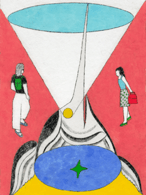
    Illustration by Julien Posture

    Dating sucks. I think there are very few Universal Truths out there, and that’s one of them; Dating, on the whole, is not a pleasurable experience. When dating works, it’s unbelievable, exciting, fulfilling, and all the other words that poets have shared for hundreds of years. But of all the unfun things that dating can conjure up in a person, the not knowing where you stand with the other person is damn near the worst. Souvankham Thammavongsa’s “Floating” tackles that feeling of uncertainty when it comes to meeting someone new, and though it is a charming piece, it does seem to trip over its own feet at the end.

    I say charming because the piece feels as if it is coming from a very authentic place for the protagonist. She is waiting to give a talk in front of people, when a gentleman strikes up a conversation with her. They have a mutual friend, and he suggests that they should all get dinner together. We learn that the protagonist has gotten out of a bad marriage, and has some additional baggage with her family, which lends credence to her hesitation and the guard she puts up with this new man. But soon, he starts to become a bit of mystery. He has to travel for many months, and their possible connection is delayed. Soon, she starts to learn new things about him that don’t totally add up, and bring into question his motivations and intentions. All of this leads the story to create that feeling of instability that only dating, or the hope of dating, can create in a person, which makes all of this relatable.

    I am a fan of stories that are about characters dealing with a situation they’re never fully able to understand. The example I always use is the film “Picnic at Hanging Rock” which is about people dealing with the mystery of what happed at a picnic. “Floating” is that type of story; the protagonist is never able to unravel the mystery of this man, and must come to terms with that. And when I said that the story trips over its own feet, I say that because she doesn’t make a decision at the end of the story. I admit that I might be splitting hairs here, but there is a difference in “floating” because one didn’t make a choice, and “floating” because one is choosing to wait and see. One is passive, the other is active and has agency. Even with an attempted “Dead Chick in the Basket”* ending to conclude the piece, the protagonist chooses to be passive, and though that might be the most realistic decision in this situation, for a short story, it’s not a satisfying narrative conclusion.

    *“Dead Chick in the Basket” refers to a story device wherein the final paragraph of a short story contains new information about a character which is meant to make the reader view the actions, statements, or feelings of that character in a different light. The first known use of this device was in J.D. Salinger’s short story “Just Before the War with the Eskimos.”

  • Short Story Review: “My Balenciaga” by Han Ong

    (The short story “My Balenciaga” by Han Ong appeared in the March 23rd, 2026 issue of The New Yorker.)

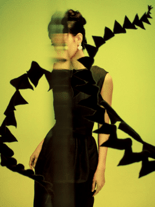
    Photograph by Harold Julian for The New Yorker

    I love the use of McGuffins as a plot device in storytelling. It gives instant motivation, and when used well, can give valued insight into a character’s constitution as they seek the MacGuffin. (In case you aren’t aware what a MacGuffin is, think of the Maltese Falcon, Ark of the Covenant or the Death Star plans.)  I would argue that the Balenciaga dress in Han Ong’s “My Balenciaga” is the same plot device, but used in a dramatic, rather that thriller/action, setting.

    The Balenciaga dress is owned by Lucy’s mother, who is a former fashion model from the Philippians. The mother received the dress many years ago while she was working as an international model, and confusingly, the dress does not contain a Balenciaga label in it, making its authenticity suspect. Lucy and her mother live with Lucy’s aunt on the Upper West Side of Manhattan, and the three lead a pleasant life in the City. The mother still continues to wear the dress on special occasion out, such as going to the Met to watch an opera. After the death of Nora Aunor, a Philippine actress, which affect Lucy’s mother personally, things begin to change in their home. For Lucy, she changes her appearance and tries on the dress, which fits her well, and soon her personal and professional life begin to develop in positive ways. Yet there is still a question over the dress’ origination.

    This is a story that hits all of its marks; it is a very competent work. Yet, I never felt like anything was at stake for these characters, such as there was no emotional peril for Lucy or her mother. I believe that Han Ong was trying to create tension with the dress by playing with the idea of “The Value of Myth.” (You know, like in “The Man Who Shot Liberty Valance” or “Lisa the Iconoclast”) What is more important; the truth about the myth, or the truth the myth creates? No matter which side of this question is answered, I felt that the characters would essentially stay the same. Hence, no tension or peril.

    Perhaps the story was a little too long, spending more time telling rather than showing, so to speak. And, unfortunately, I think you could have taken the aunt out of the story, and it wouldn’t have changed anything. But, I did enjoy the character of Lucy, and found her journey in the story compelling; the search for connection with her mother. Which is why I see the Balenciaga dress as this story’s MacGuffin.

  • Short Story Review: “The City is a Graveyard” by Addie Citchens

    (The short story Short Story Review: “The City is a Graveyard” by Addie Citchens appeared in the March 16th, 2026 issue of The New Yorker.)

    Photograph by Nydia Blas

    There are many things that I enjoyed about Addie Citchens’ “The City is a Graveyard,” but the one I found most enigmatic was how every time the protagonist first mentions a man in her life, she lists his Zodiac sign. What made this so interesting to me was that this was a story about her existential existence, yet these men were beings of Zodiac influence. A fascinating dualism, creating a song that I could see Apollo and Dionysus dancing to.

    Another aspect of this story was Citchens’ use of second person narrative. The use of this style can create an immediate feeling of immersion for the reader, forcing us to embody the protagonist. Yet, in this story, I don’t feel that was the intended use. The “you” is in fact the protagonist speaking to herself, attempting to objectively examine these specific events from her life. I came to this conclusion because near the end of the story, when a man approaches her while she is sitting on a bench, he says to her, “I been watching you sit on this bench talking to yourself.” The story is the protagonist dialogue with herself. I could be wrong, I doubt it, because isn’t that how we talk to ourselves in our minds? “What were you thinking” “Why would you do that?” Well… I do anyway… For me, it creates an honesty and authenticity in the protagonist.

    Because this is a story about the protagonist being honest to herself about the decision and choices she made in her life especially when it came to intimacy, pregnancy and abortion. Some were planned, some weren’t, but each were different and affected the protagonist in different ways. Citchens’ presents us with a protagonist who is complicated, not easy to define, maybe a little messy in her life (who isn’t) but this is a character who is fully well rounded in three dimensions. In essence, she’s might be conflicted on how to feel about herself, and the decisions that she’s made, but in the end, the decisions are hers.

    I am leaving lots, and I mean lots, of details out of this story, as I don’t want to ruin how the story is built, and the way the climax unfolds on a bench. I do want to add that there is another character in this piece, which is the city of New Orleans. Not only the climate of the place (hot, humid, sticky) or the tourists everywhere, but the music, and the history of that place. Citchens’ uses, for lack of a better phrase, subtle notes in the narrative on how this location is essential in the telling of this story. New Orleans is a place where the ghosts of the past are never out of sight, but it is also a place of possibility, where a future can always been seen.

  • Short Story Review: “Something Familiar” by Mary Gaitskill

    (The short story “Something Familiar” by Mary Gaitskill appeared in the March 2nd, 2026 issue of The New Yorker.)

    Photograph by Billy Dinh for The New Yorker

    “Something Familiar” by Mary Gaitskill is one of those short stories that feels like it’s from another time, like the 70’s or 80’s. A contemporary set story, but the setting, a late-night taxi ride with two strangers conversing, feels quaint, and even a little nostalgic. And I do think that this choice was deliberate, as the story also involves these two people reflecting on the life they lead back in the 80’s.

    Overly Simplified Synopsis: A taxi drive and his passenger converse with each other, which causes both to reflect on their lives. Also, there is a possibility that they shared an important moment with each other, though they aren’t aware of this coincidence.

    This is a competent story. The characters feel lived in, and make decision on how they present themselves to the others. Perhaps it is a coincidence that these two people find each other in a cab, and I wouldn’t disparage a story using coincidence as a plot device, though I did enjoy that Gaitskill never fully says that these two people met before, which keeps the story feeling tactfully undefined – rough on the edges. I also appreciated how, when the two characters split up and go their separate ways, the woman has someone in her life she can be open and honest with, while the man lives a life in a lie with some regret added on top.

    Yet, it never felt like this story went anywhere, or progressed in some way. The characters are the same from start to finish. They do reflect on their past, but that reflection doesn’t lead to growth in the present setting of the story, which leaves the piece in a sort of unfulfilled status bubble.

    Things happen, yet nothing happens, making the story feel incomplete and unresolved.

  • Short Story Review: “Predictions and Presentiments” by Valeria Luiselli

    (The short story “Predictions and Presentiments” by Valeria Luiselli appeared in the February 16th & 23rd, 2026 issue of The New Yorker.)

    Illustration by Jesús Cisneros

    “Predictions and Presentiments” by Valeria Luiselli is a short story that gave me a reassuring hug. The reassuring didn’t come in the form of any answers to the questions which the story brought up, but it reassured me that life is about growth and discovery.

    Overly Simplistic Synopsis: After a divorce, a mother and her daughter spend time in Sicily, not too far from where the mother’s grandmother is originally from. And they try to cook a swordfish head, too.

    In the story, the main character has a small mosaic fragment of the god Proteus which her grandmother obtained/stole from an archaeological dig she was working at. The mosaic fragment is a clever dramatic device in the story. But I had this thought in my head that “Predictions and Presentiments” was a bit like Proteus; it kept shifting and changing. Was this a story about just the narrator, a mother, and her daughter? Was it about her grandmother as well? Legacy trauma? Family origin story? Connection to the past, or the ancient past? What truths do we share with our families, or do we make fictions out of those truths? Can we change who we are, or we destined to our nature? Is our future but a guess, or is there a way to logically know what’s coming?

    This is a story that walks a very nice tightrope of keeping it all together. I couldn’t shake the feeling that at any moment the mother and daughter could spin off into ruin. I can’t say where in the story I got that from; perhaps it was the refrain of starting over in a new place, the perils that come with beginning again, and discovering something new? Maybe it was the climax of the story, or the fishmonger who sold the fish head? Or it could have been how not everything that happened in this piece got wrapped up neatly, or fully explained? This created a feeling of fragmentation, that Proteus mosaic again, but Luiselli held it all together. See, it reassured me that life is messy, not neat, but wonderful to experience.