Tag: #review

  • ODDS and ENDS: Proof of Workouts, Sitting Still, and Goodbye Playlists/Hello Albums

    ODDS and ENDS: Proof of Workouts, Sitting Still, and Goodbye Playlists/Hello Albums

    (And Sunday always come too late…)
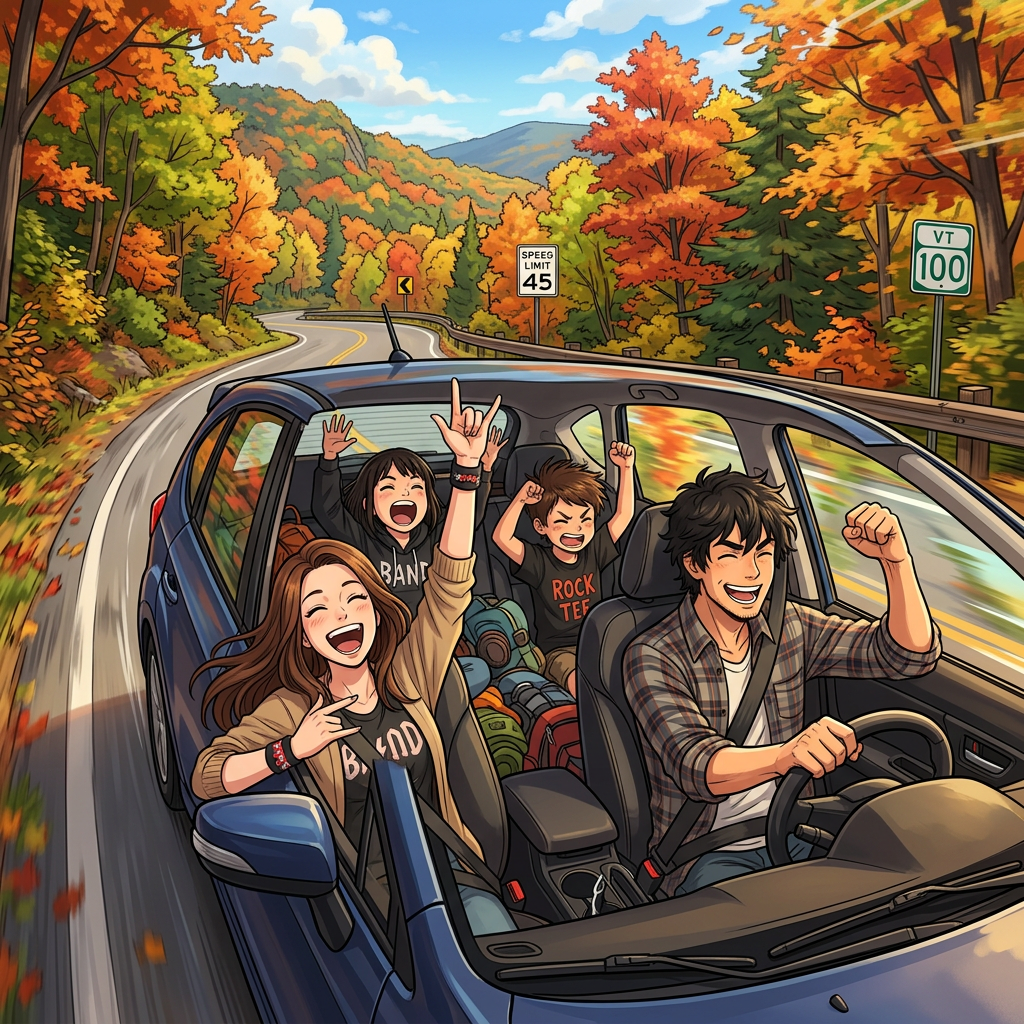
    Four people in a car driving through a forest with vibrant fall colors, all cheering and smiling
    A happy group enjoys a fun autumn drive surrounded by colorful fall foliage.

    My kid doesn’t believe that I do exercises. She knows I go to the gym, as she’s seen me do it. What she doesn’t believe is that, while she’s at school, I doo push-ups, sit-ups, and squats at home. She wants my wife, her mother, to take pictures or shoot a video of me working out at home. I don’t know how to feel about my child doubting me on this matter. Is she saying that I would lie about this? Or is she saying that there has been no progress in my size, so I must be lying? Or is she just making fun of me?

    We rented a place in Vermont over Memorial Day weekend, and we all had a good time. One thing that I noticed about myself was that I had a very difficult time just sitting still, being quiet, and not moving. The whole family has been under a great deal of stress this Spring, with jobs and school, and life in general, so the break was needed. But, with my inability to just be calm of twenty minutes, I started to wonder if I have burned myself out, and started to get use to feeling edgy all the time; as if stress is my default state, and I need to constantly engage in something.

    See, when we were driving back to New York City from Vermont over Memorial Day, we got stuck in some pretty bad traffic around Albany, and we started getting bored with our playlists. So, the wife asked what album did I want to listen to. The first thing that popped into my head was “Achtung Baby” which she put on, and it still holds up as a great album. Then the wife suggested “Ten” which was awesome to listen to as well. The kid wanted to listen to “Guts” which we all enjoyed. When we made it home, we decided that for this summer, for all of our road trips, we are only going to listen to albums. I had forgotten how much fun it was to road trip and go from album to album. Not since the days that I had a cd player in my car, had I done this.

  • Short Story Review: “The Queen of Bad Influences” by Jim Shepard

    (The short story “The Queen of Bad Influences” by Jim Shepard appeared in the June 16th, 2025 issue of The New Yorker.)

    Illustration by Naï Zakharia

    Reviewing stuff is fun. Clearly, because I do it often. Who doesn’t like sharing their opinion and acting like an expert? It’s all fun and games until you hit a critical theory paradox; Is it possible to acknowledge that a story is good, and well written, but at the same time does not resonate or move me? That was the situation I ran into when I finished reading “The Queen of Bad Influences” by Jim Shepard.

    To be clear, “The Queen of Bad Influences” is a good story, well written, and I have no qualms in recommending that you should read this story because it has a very relevant theme, is constructed well, is insightful, has a bit of action and tragedy to it, the protagonist is engaging and grows over the story, and the use of language is spot on. All the boxes are checked here.

    Yet, I just didn’t feel anything.

    Look, I write these reviews for my own enjoyment, and as an exercise in analyzing what makes a short story work, or not work, so I might improve my ability as a writer. On the whole, I will only review a work if it moves me, garners an emotional reaction, either positive or negative. If I don’t have a reaction, then I let it go and move on. (Now, if someone wants to pay me, I’ll review whatever you send me.) These aren’t deep philosophical rules that I follow, but more like functional guidelines.

    When I finished “The Queen of Bad Influences,” I didn’t have a reaction to it. At first I was going to write something negative about the piece, but the more I thought about it, the more it didn’t seem accurate to do it. I went back through the story, and I really couldn’t find a fault with it, save one line, but that wasn’t that big of a deal. What I came to accept is that this isn’t the story or the writer’s fault, it’s me. This is just not my thing.

    Let me try putting it a different way, which my Gen-X grunge mind can appreciate; “The Queen of Bad Influences” is like Alice in Chains. I get why people love the hell out of Alice in Chains. Alice in Chains was made up of some really great musicians, who wrote some really great songs. I’m not an Alice in Chains fan because they suck – I’m not a fan because they don’t resonate with me the way Nirvana, or Pixies, or a host of other grunge bands do. It’s me, not them.

    It’s me, and not Jim Shepard and “The Queen of Bad Influences.”

    Anyway, go read this story. You’ll enjoy it.

  • Short Story Review: “Nocturnal Creatures” by Saïd Sayrafiezadeh

    (The short story “Nocturnal Creatures” by Saïd Sayrafiezadeh appeared in the May 5 th, 2025 issue of The New Yorker.)

    Illustration by Anuj Shrestha

    I like this story a lot, so I’m not gun’na fart around with some cute opening here. “Nocturnal Creatures” by Saïd Sayrafiezadeh is a very good story and you should read it.

    Overly Simplified Synopsis: A exterminator meets a single mother and her son while on the job, and they all become involved.

    To start with, Saïd Sayrafiezadeh crafts this story very well. Every time I have read this story, I keep coming to a better appreciation of how all the pieces of this story are laid out, how they interlock and interact. For example, the first section of this story establishes the character of the exterminator, how he views himself and his job. Then going into the next part, when he meets the mother, we are shown the ways she tries to take care of herself and her son which leads us to understand, from the previous section, why the exterminator would identify with her. It’s a little cheesy to say this, but Sayrafiezadeh does an excellent job of “showing” us who these characters are, and not “telling” us. (And somewhere in the world, a creating writing professor just got his wings!) But seriously, each section builds on the previous, creating a momentum in the story with their actions. The narrative never gets mired down in explanations, because Sayrafiezadeh provides a clear understanding of these characters motivations by what they are doing.

    And these are characters that have lived, and maybe they haven’t had the best breaks in life, but they aren’t broken either. There is an optimism to them, but also a melancholy. Are they repeating past mistakes, or trying to make amends for their past? I was fascinated with how the exterminator never said he cared about the mother and her son, but his actions were that of a guy who wants to take care of them. The fact that he gave up his day sleeping time to be with them, wasn’t lost on me. And this was a mother who hadn’t given up on her ambitions, but she knew she had responsibilities which she did her best to uphold. I felt I knew these people, and wanted them to succeed, to carve out the happiness they deserved. But there felt like a little dark cloud hung over their lives, keeping the story grounded in realism, because life’s not always fair, no matter how good intentions attempt to be.

    I wanted it to work out. I wanted them to be happy, but there isn’t a clear, concrete answer to what happens next, and that’s okay. I’m good with the decision that Sayrafiezadeh made to end it the way he did. Maybe it’s a bit of a ploy – yet I would argue that over the course of the story, we have been shown how these characters continually make choices to be together. So why would that change at the end of the story when they reach the crux of their situation?

  • Short Story Review: “Something Out of a Horror Movie” by Mario Aliberto III

    (The short story “Something Out of a Horror Movie,” by Mario Aliberto III appeared on February 27th, 2025 in Milk Candy Review.)

    (Image from Milk Candy Review)

    When I was a teenager, and well into my twenties and beyond, I spent hours debating with my friends about the mechanics, tropes, and clichés of horror movies. How most horror movies, more than any other genre of film, are made up of an uncountable number of rip offs and copies of more successful horror movies. For myself, as a person who loves awful movies, bad horror films are an entertaining gift that just keeps on giving.

    So, when I started reading Mario Aliberto III’s “Something Out of a Horror Movie,” I was intrigued as to what he was wanting to accomplish is this flash fiction story. It reads like it was written but someone who loves the awful character clichés of the genre. What I appreciated in this piece was that as I started reading it, I couldn’t put my finger on if this is a story about characters in a horror movie, or if they are characters in “real life” that find themselves in a horror movie situation, or if these are characters that have seen too many horror movies and went to that places because of the situation they were in. By doing that, structuring the story that way, left me feeling off balance which played very well to the theme of the piece, and ultimately the climax of the story.

    But what I enjoyed most was that this story took a stock clichéd character that I have seen in millions of horror movies, and made me think of her differently, and also made me view her actions in a fully well-rounded way for that character. Aliberto does this rather effortlessly, and compactly. The last paragraph is just great.

    I will never look at the Bad Girl trope character the same way again.

  • Short Story Review – “Séance at the Dinner Party” by Tori Palmore

    (The flash piece “Séance at the Dinner Party” by Tori Palmore first appeared at Rejection Letters on November 27th, 2024.)

    Families can suck, and in literature, this is fertile ground for inspiration which has been plowed many times over, and will forever produce material that will be harvested for our consumption. As I get older, family dramas have become more fascinating to me, and Tori Palmore’s “Séance at the Dinner Party” is a absorbing stream of consciousness entry into the field.

    The narrator takes us through their thoughts/experience/emotions at this family gathering, I believe it is Thanksgiving. There is the subtext of death and the loss of a sibling, perhaps the narrator’s safety at these gatherings, and the repetitive “Brother is Dead” adds a staccato rhythm to the prose, keeping the piece unsettled. I appreciated Palmore’s use of short sentences to build tension and keep the emotions and reactions moving forward. The piece never feels like it can stop, that it will perpetually play over and over again, not only in the narrator’s life, but also in the mind, even when they leave this dinner party of family. How the narrator is uncomfortable with their family, how they don’t feel accepted, to the point of micro aggressions signaling that they are not fully accepted. Yet the narrator keeps their rage, even grief, in check. Though the narrator does escape this evening with their family, the ironic knowledge is that this event will repeat itself again.

    Palmore’s “Séance at the Dinner Party” is the type of flash fiction I look forward to reading. It is direct, clear, and puts me in a moment or emotional state that I can relate to, or learn from. And in the piece, Palmore also creates a moment that also feels as if it exists outside of time, which adds to the resonance of the story.