I had the hardest time coming up with a solid opening paragraph for this review of Kara Melissa’s non-fiction piece “They Only Come Out at Night.” I like to think that I’m good at introductions, but not this time. The issue I am having is how I can’t wrap my arms around this essay to find one single starting point to explain how this honest, interwoven, melancholic story affected me.
From the first paragraph, Melissa pulled me in with an intense honesty; confidant in its story telling. Not for shock value, nor did this feel like oversharing, or a performative confession. This was a clear declaration of deep emotions, fully self-aware that maybe some people wouldn’t understand this situation, but it was true.
What follows are three tangents, platted together with connecting themes of MRI’s, hospitals, logic, brain function, and most importantly love; the compassion, empathy and longings which form in situations Melissa finds herself in. Through all of it, I felt this wrap of a happy melancholy resignation to it all. I wish I could explain that better, but it’s what I feel someone who has loved deeply, and lost greatly would feel towards the world.
I relished how the essay is presented straight forward and logical – The descriptions of medical treatments, aliments, and the causes. The setting is during the Covid lockdowns, and with the clinical narrative, Melissa creates a feeling of isolation and detachment. This makes her desire for connection, understanding, and compassion all the more pertinent.
I don’t want to belabor this review, as I am purposefully not going into all the details of the essay, because you should go read it. But I will say that the last section left me with a wonderful feeling of hopefulness. That even in the darkness, when we feel lost, that the love we have for each other can carry us through. With everything going on, I needed to be reminded of that fact.
(This isn’t a review on The Pitt, though I might do one at a later date. Anyway, I just wanted to state that at the start.)
When my daughter was born, I discovered that all of my emotions were right at the surface. It didn’t take much to make me cry; my baby girl holding my finger, or falling asleep on me would cause a gush of joyous tears out of me. But I also began to notice that commercials that had to do with parents and kids would make a big softy outta me. I even cried watching a Simpsons when Marge sang a lullaby to Bart. I wouldn’t call this state sensitive, nor thin skinned, but it was a state where I felt that it was very easy to tap into what I was feeling. Maybe everything didn’t make me cry, but I was able to feel everything. I learned to control it, but “control” isn’t the right word – I learned to work with it, might be a better description.
The only other time I felt that way was when my mother was in the hospital, and the fear of her death made me and my whole family exist without much of an emotional filter. When the doctor confirmed that she was, in fact, going to die and there was nothing that could be done to save her, what littler filter we had dissipated. One moment we would be normal and having a conversation, and then something would snap, and we would just explode in tears – just loud painful sobs. Then it would pass, only soon at any moment we would again break in sobs, tears of grief. After she passed, we all dealt with her death in our own ways; each person’s mourning was their own. We were there for each other, but we all took different paths in dealing with it.
For me, I just tried to plow ahead. I had a kid to take care of and a family to provide for. I was left feeling sad all the time for about two years. Not so many tears after that first year, but on special days, holidays, birthdays; the sadness would return, but anger started showing up for me as well. I have been trying to work through my anger and sadness. I through myself into art, creative outlets, and putting a few additional pictures of my mother up around the home. It’s been almost seven years, and talking about her doesn’t hurt anymore, which I know is a sign of progress.
But there are a few areas that I know I have been avoiding, or not processing well. One of the oddest manifestations of my avoidance is that I pretty much won’t watch medical shows. Anything with doctors or hospitals, I will come up with a reason not to watch it. I won’t even watch reruns of M*A*S*H or ER. And I know 100% why, and it’s because I don’t want to relive any of those feelings of watching my mother slowly die in a hospital bed.
But I am a huge ER fan, and curiosity got the better of me and I started watching The Pitt, and sure as shit there is a story line about an elderly father not wanting to be intubated to stay alive, and his adult children over rule his wishes. The show didn’t shy away from showing the pain and discomfort the father was in, as well as showing the confusion, guilt, shame, and fear of having to make end of life decision for your parents.
The situation in the show was not exactly like the one me and my family went through with my mother, but it was painfully close enough. And as I watched the story unfold, the vice in my head kept telling me to shut it off, it was late, go to bed, you have an early morning, reliving your pain won’t help… But I pushed though it. I let myself go back there. Feel it again; the fear and pain, and numbness and rawness and confusion – sometimes not knowing how I was going to survive this. How was I going to keep living without my mother? How was I going to live with this loss, this pain, all of this that will never go away?
I sat on my couch at 1am and just cried for a while. I don’t even know if the show was that good, but I know I let something out that I haven’t been acknowledging existed in the first place. I have been dodging that final week of my mother’s life. That week where she was in a hospice bed with a morphine drip, and it was my mother but it wasn’t. She wasn’t there, and we just listened to her breathing with everything and nothing passing through my head. I sat there watching her dying, and we all spoke to her, but she was never going to respond back to us. I just wanted my mom to touch my hand and tell me that she loved me, but that moment had passed. All I could do was watch and wait, and it was so painful.
I am still processing, and a dear friend did say to me that we never stop processing losing a parent; it just becomes a part of who we are. I think they’re right, and I love them for their honesty with me. I still have places and emotions I need to work through. Recesses that refuse to come into the light of day. I know where they are, and what they are. Just not always ready to deal with them yet.
(The short story “Our Time is Up” by Clare Sestanovich appeared in the November 13th, 2023 issue of The New Yorker.)
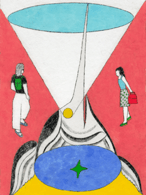
Illustration by James Lee Chiahan
You know, and I’m not stepping out on a ledge here, but there should be more stories about mothers and daughters. For centuries, the literary cannon is filled with stories of fathers and sons – even a couple of religions revolve around that idea. So, when I see a story that is about mothers and daughters, like Clare Sestanovich’s “Our Time is Up,” I look forward to delving into these relationships, which sometimes can be very dramatic and enlightening.
This story revolves around Angela, who is entering the first stages of middle age, and beginning to wonder about the decision in her life. Her yardstick of measurement is her mother, which leads to uncomfortable comparisons. Angela is relatively happily married, though her and her husband, Will, are in couple’s therapy. There are a host of issues they are addressing, such as if to have children, and Angela’s aging parents. There is a slight hint of depression in Angela, an unwillingness to move forward on some of her issues. The story takes Angela and Will to Angela’s parent’s home, which needs to be cleared out as it is becoming a hoarder’s house. They also explore, by taking a tour, of putting Angela’s parents in assisted living. Some more tangents are sprinkled in the piece, so you can see that there is a lot going on here.
Which leads me to my chief criticism of this story; there is too much going on which doesn’t allow these details to be fleshed out. I can see that Sestanovich was trying to make the point that Angela’s life is complicated and busy, and she has trouble giving each person and issue, let alone herself, the time that they need. The way this is presented leaves some characters flat, while other situations feel rushed. Will, the husband, plays only one note in the story, with no depth or insight. The father is barely present, having only one job which is to fall thereby starting the conversation about assisted living, and then he serves no other purpose. There is the cleaning of the hording house, which seemed like it was primed for dramatic action, but is just breezed over.
I say all of this because “Our Time is Up” doesn’t feel like a short story, but the first chapter of a novel. There are so many wonderful places that these characters could go to be fleshed out, giving them depth and authenticity. Especially Angela, who in this story, is more like a middle-aged person who just wonders why things happen to them, and never makes a decision or choice. Even the climax of the piece, a coffee mug made by her mother which breaks in Angela’s luggage, is a situation of something happen to Angela, and not Angela taking an action or making a decision.
And I was rooting for this story. As I got closer to the end, I kept expecting a dramatic or revelatory action to take place. (I will credit Sestanovich with avoiding the cliché of someone dying, which I think is what most writers would have done.) But it doesn’t arrive. I was also expecting Angela to grow in some way, but she seems to end in the same place where she started, which left me feeling unsatisfied with the story. It’s too bad, as the writing is very good, and the quiet insights of Angela’s life are intriguing. And if there was a second chapter, then I would very much want to read that novel.
I remember I was in a writing group back in college, and the professor leading the group said he had two rules that he wanted us, a group of burgeoning writers desperate for approval, to follow; 1. Don’t write about yourself, and 2. Don’t write in second person. I understood the first rule because it’s hard to be objective about yourself, but the second rule, that I never got. What’s wrong with second person? Now, I’m not saying that “Quaintrelle” by Kristin Garth is about Kristin Garth, but it is a short story written in second person. And it works.
The story doesn’t mess around and starts off with a good hook; there is a salacious mystery, the “you” protagonist is defined, and the antagonist is also delivered as “…your devout Mormon mother, also the assistant principal.” It was very effective opening, as I knew the sides, and understood what the conflict would be. And we are introduced to the “bad girl” of the gifted class – Mavis Tate. Mavis takes an interest in you, and you are thrilled by this girl who is popular but also doesn’t fit in, just like you don’t fit in, but in a different way. The conflict is the mother trying to stop the influence of Mavis on you.
With the plot of this story being defined early, and rather straight forward, it left Garth ample time to delve into the pull of Mavis on the protagonist. I also liked that these kids were smart. The protagonist is smart enough to know that she is being taken in my Mavis for a reason, some ulterior motive, but the desire to be “cool” and accepted in junior high is so great, that she cannot say no, even though she knows there will be a priced to be paid. And also, Mavis knows the right things to say, the words that need to be used to push the right buttons to get the protagonist to follow along. But ultimately, the protagonist knows that she is up against a force and a will that she cannot defeat; her mother. Even when the mother tells her the truth of Mavis, it only backfires. The protagonist acquiesces to her mother demand that she not be friends with Mavis, but that destruction of the friendship only creates a new, internal rebellion as the protagonist learns that mother cannot control her thoughts.
See, second person can be used well as a dramatic device. Especially when used by a good writer.
(The short story “Returns” by Annie Ernaux appeared in the November 14th, 2022 issue of The New Yorker.)
(Yes, I will SPOIL this story.)
Illustration by Sébastien Plassard
The New Yorker publishing a shorty story by Annie Ernaux for this issues, is the equivalent of a company softball team bringing in a ringer to bat cleanup; Like this story was going to be bad. Such is the world of publishing a Nobel Prize winner writer.
But why was it good?
The story is simple, or, more like, is direct and to the point. Plot wise; Daughter comes to visit her elderly mother who lives alone. But the first sentence sets the tone for the piece succinctly:
The last time I saw my mother at her home, it was July, a Sunday.
Immediately, there is a feeling of sadness, mourning, even regret, coupled with Summer and a feeling of relaxation as it is a Sunday. We are loaded with emotional information that only us and the writer know. We have been made a confidant as well as a witness as to what will follow.
The story is told in three sections, three acts. The first, the introduction of the setting and characters, as well as showing that there is some awkwardness between the mother and visiting daughter. The second section goes deeper into the awkwardness between mother and daughter, showing that the teenaged years were difficult and filled with fights and screaming. These are two people trying to make amends; the mother wanting to daughter to stay longer – offering gooseberries -, but the daughter is willing to leave early if the conversation lags. And the third section, the narrator acknowledges that the mother has no power over her anymore. The memories of the narrator’s former life come back to her, again showing that she was unhappy there, and wanted to leave. Then a stray cat arrives, which the mother feeds and allows to stay, and for a short time the mother and daughter find a subject of conversation. And then the climax, the daughter goes to leave, but the mother gives her a form she needs help filling out, but the daughter refuses to do it at that time. The daughter promises to fill it out and send it back to her mother at a later date, which upsets the mother. Then the narrator describes leaving the town, and how the places fade behind her in the distance. Finally, we learn the mother soon suffers sunstroke and is admitted to the local hospital. When the daughter returns to the home, she finds the gooseberries in the refrigerator that she forgot to take, but now the berries are spoiled and brown, liquid lump.
This story flows easily like water in a stream; it gently takes you where it wants to go. It moves so well, that all the little tricks to elicit an emotional response are but ripples on the narrative. We know that death is coming from the first line, and short stories love dealing with death, but Ernaux talks about death by not saying death. It is hinted and lingers in the background of what is to follow. As the story continues, there is the tension between the mother and daughter, shown by the slight bickering about locking the front door. Moving deeper in, we learn the reasons for this tension, knowing that this is not something that is easily overcome. But these two don’t hate each other, as when the cat arrives, we see that they can connect and share. But as we know, all visits must end, and we see how the mother tries to prolong their time. By this point, we understand each characters motivations, what they want, and how they cannot give the other what they need. The melancholy comes through these passages. These are the last moments, and this last interaction isn’t acrimonious, but also not affectionate either. This is the parting one has when you believe there will be another Sunday, and another chance to make up for lost time. It is all implied, and never directly spoken. And as the daughter rides the train home, and she does love her mother, from her description of leaving, we know that she doesn’t want to be there. And when the end of the story arrives, as we knew it would, the gooseberries in the fridge serve as the button for the story; the lost opportunity that withered and died.
In talented hands, storytelling seems so simple and effortless. Breaking this story down, examining it, it’s like I can hear the important notes that Ernaux is hitting in the middle of this melody of a story. It is impressive, this level of skill.
Annie Ernaux doesn’t need my endorsement, but she is a ringer.
(Speaking of which; Yes, that’s right; Speaking of which, if you have enjoyed what you read, take a moment to give a like, or a share, leave a comment, or follow this blog. Not only does it help my standing, but it will help agents verify that I have a following.)