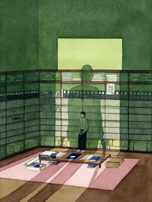
(The short story “Project” by Rachel Cusk appeared in the September 1st & 8th, 2025 issue of The New Yorker.)
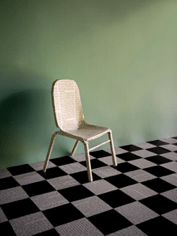
Photo illustration by Stephen Doyle
I am a big fan of Rachel Cusk; have been for some time now. There are a great number of reasons why I enjoy her work, and when I read anything by her, such as “Project” in this week’s New Yorker, my fandom evolves into admiration, and even a little jealously. I am not jealous of her talent as a writer, envious might be the better word for that, but when I read her work, I wish I was the type of writer that had time. Cusk’s fictional version of herself, though narrator might be a fairer description, possess the greatest gift of all; time. Time to observe and contemplate.
In “Project,” the narrator contemplates how who we are gets created. This contemplation leads to a path that bends and turns and takes us to people in the narrator’s life. First we meet M, a movie star and model. The narrator is thinking of writing M’s autobiography, which M’s response is to “…just make it up.” In this first section of the story, the narrator intertwines her interactions with M, while also speaking of a book she is reading by a woman who details the horrid abuse she suffered at the hands of her stepfather. It is a strange comparison, if not a juxtaposition. In Cusk’s assured hands, we see how these woman took their situations, fought back and went forth to create better versions of themselves, yet both spoke of a moment where their childhoods were lost… But even as I try to describe this, I am not doing this story justice. The story moves on the narrator’s partner, and his bout with an aliment and the need to a brief stay in a hospital. Then there are questions of the time we have and how we share it. Why we live the way we live and where we live…. See, not doing this justice.
This story falls into my favorite Cusk style of writing – It just flows. Maybe this type of writing is like stream-of-consciousness-lite. These thoughts and ideas have depth and weight to them, but they don’t get tangled up in minutia and tangents. All of these disparate ideas roll across the page, with observations of the life the narrator lives, but also how some of these truth and universal; Or at least there is a hope that they are. This is a story seems to be celebrating the existential gift of being able to create our self, and chose how to live out that creation. And to do all of this, to have a life that can be observed, we need time for reflection.
And through all of it, the ins and outs of this story, Cusk has a wonderful melancholic final paragraph. Not so much an observation, or a contemplation, but a memory of raising her children; when trust was tangible and innocent. That taking the time, to remember and re-experience, is a continuous step in the project of self creation.