Tag: Japan

  • Short Story Review: “Hatagaya Lore” by Bryan Washington

    (The short story “Hatagaya Lore” by Bryan Washington appeared in the March 31st, 2025 issue of The New Yorker.)

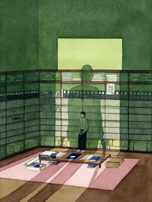
    Illustration by Kotori Mamata

    When I moved to New York City, a place I always wanted to live in, it took years before it felt like my home. It took even longer for the guy who works at the bodega at the end of the block to acknowledge me at a regular in the neighborhood. (He now calls me “chief” instead of “you.”) But gradually, it started to feel like my home, and now it’s hard to think of it as anything but. Bryan Washington’s “Hatagaya Lore” examines how a place can become your community, and then your indispensable home.

    Here’s an overly simplified synopsis: The narrator and his husband move to Tokyo from Dallas. At first the narrator isn’t sure how to fit in, but soon finds his community, which leads to changes and growth.

    What I loved about Bryan Washington’s story is how he intersects community and intimacy, and the connections that are created from it. The narrator goes out and finds a community that he can connect to that sustains him as he journey in Japan. Yet, there is also a need in the narrator for more of an intimate connection with people, which isn’t always sexual, but is necessary to keep the narrator grounded, as the person he is growing into is beginning to flourish. Also, I liked Washington’s choice to have the narrator tells us, ever so briefly, about other relationships the he has had over the years in this story, but aren’t explained in detail, thus creating a feeling of trust and confidence between the narrator and us the reader; that we are only being told what is most important to the narrator, and nothing superfluous. It’s as if we are being added into the narrator’s community. Finally, I commend that the climax of this story is not the narrator “realizing” something profound, but is the narrator listening and observing.

    Bryan Washington’s writing skills are just phenomenal. He is one of my favorite “less is more” writers out there. Spartan is a fair description of how he describes most things in this story, but I am never left wanting for more, or feeling that details are missing. I appreciated how subtly the disillusion of the marriage was shown. In this story, a scene of their breakup isn’t needed, but showing that moment when the trust between the couple, that break in emotional intimacy, spoke volumes about the state of their relationship. And this story is peppered with moments like that, where there is a breath and space in this writing that allows weight to be infused in these situations.

    I’m a fan of Bryan Washington, and I can admit that I might not be the most objective person when it comes to evaluating this story, but eh… It’s a good story all around. I enjoyed being with these characters, seeing them interact, and watching them grow and find their place in the world. Some homes are made, while others are discovered.
  • Short Story Review: “From the Wilderness” by Yukio Mishima (Translated from the Japanese by John Nathan.)

    (The short story “From the Wilderness” by Yukio Mishima appeared in the November 4th, 2024 issue of The New Yorker.)

    Illustration by Joanna Blémont

    How does the phrase go; “The unexamined life is not worth living.” At least, that’s the philosophical dictum that has been credited to Socrates. Some days, I think that is the job of a writer; to examine life and make it worth living. That was the mind space I was put in when I finished reading “From the Wilderness” by Yukio Mishima.

    Here’s my overly simplified synopsis: A mental unbalanced youth breaks into the home of the author, which causes the author to contemplate life and loneliness.

    Couple of things here. I appreciated the structure of this piece. The first part was from the author’s point of view of the incident. Then the second part was an overall description of the entire incident, showing how the other people in the home reacted. Then the final part was the author contemplating the event, trying to make sense out of it. In this structure, the narrative of the event goes from very narrow, to expanding to a wider view of the many people in the home, and finally taking in the world of the intruder, and the larger world in general. In this way, the narrator goes through a progression of expansions, which leads to the author having a new understanding of the world he lives in, and creating a feeling that a journey has commenced.

    But what I enjoyed most was that this was a story that took its time. Mishima was patient with his storytelling, letting the ideas of loneliness evolve and develop, which had a natural and authentic feeling to it. I know this is a work of fiction, but with the narrator also having the same name as the author, it creates a conundrum of how much of this is fiction, or reality? Sure, it’s a device, but played well here as it lends itself to give a legitimacy to the thoughts and conclusions.

    They don’t make stories like this anymore. Short fiction that enjoys language (Bonus points to this translation,) playing with language, and isn’t afraid to take time, but not waste our time. Maybe this wasn’t the most profound story I have read recently, but Yukio Mishima reminded me that life is meant to be examined.

  • Nabemono – My New Food Fixation

    We are in the middle of Summer, and I am already thinking about Fall. Anticipating might be a better word. Fall is my favorite time of year, and I have the flannel and sweaters to prove it. There is the apple picking, leaves changing, Halloween and Thanksgiving. Autumn also means a switch to our menu at home, as we start eating heartier things due to the colder weather; soups, stews, and baked goods. While searching for new recipes for Fall, I came across nabemono, or Japanese hotpot cooking, which I have become fixated with.

    Nabemono is simple in concept, and complex in flavor and execution. It just means one pot meals, with a protean, vegetables, broth, noodles, and a dipping sauce. The pot is placed on the table, in some cases while on a heating plate, and people take what they want out of the pot and eat communally, or family style.

    I came across nabemono when I was looking up fast family meals from all over the world. I mean, America can’t be the only place where feeding a family quickly and cheaply is a major concern, and I was correct – seems to be a concern all over. If one doesn’t have a traditional nabe pot, a Dutch oven can be used as a substitute. And I have a Dutch oven! Also, nabemono has several different varieties – like shabu-shabu, chankonabe, and sukiyaki – as well as regional variations, which means that there are tons of different recipes out there to experiment with.

    I have been doing my research, and counting down the minutes until it is Autumn. I could give it a shot now, but it is like 90 degrees in NYC, and with 75% humidity so the thought of having a soup on a day like that doesn’t sound like the best idea. I need it to be like 65 outside, which is like late September. That’s a bit of a wait, but I can be patient.

    I’ll just keep searching for YouTube videos… like this…

  • Ninja! Ninja! Ninja!

    I love the work that Rob hill does putting these videos together. Rob does and excellent job putting these videos together which document the histories and behind the scene stories of these movies. As a guy who loves bad and B-movies, Rob is endless entertaining, and hilarious.

  • We Should All Have a Theme Song, Like Gamera

    This theme gets stuck in my head, and it takes days, even weeks, for it to go away.