(The short story “From the Wilderness” by Yukio Mishima appeared in the November 4th, 2024 issue of The New Yorker.)
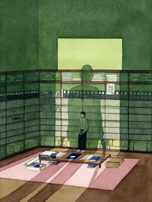
Illustration by Joanna Blémont
How does the phrase go; “The unexamined life is not worth living.” At least, that’s the philosophical dictum that has been credited to Socrates. Some days, I think that is the job of a writer; to examine life and make it worth living. That was the mind space I was put in when I finished reading “From the Wilderness” by Yukio Mishima.
Here’s my overly simplified synopsis: A mental unbalanced youth breaks into the home of the author, which causes the author to contemplate life and loneliness.
Couple of things here. I appreciated the structure of this piece. The first part was from the author’s point of view of the incident. Then the second part was an overall description of the entire incident, showing how the other people in the home reacted. Then the final part was the author contemplating the event, trying to make sense out of it. In this structure, the narrative of the event goes from very narrow, to expanding to a wider view of the many people in the home, and finally taking in the world of the intruder, and the larger world in general. In this way, the narrator goes through a progression of expansions, which leads to the author having a new understanding of the world he lives in, and creating a feeling that a journey has commenced.
But what I enjoyed most was that this was a story that took its time. Mishima was patient with his storytelling, letting the ideas of loneliness evolve and develop, which had a natural and authentic feeling to it. I know this is a work of fiction, but with the narrator also having the same name as the author, it creates a conundrum of how much of this is fiction, or reality? Sure, it’s a device, but played well here as it lends itself to give a legitimacy to the thoughts and conclusions.
They don’t make stories like this anymore. Short fiction that enjoys language (Bonus points to this translation,) playing with language, and isn’t afraid to take time, but not waste our time. Maybe this wasn’t the most profound story I have read recently, but Yukio Mishima reminded me that life is meant to be examined.


