Tag: Han Ong

  • Short Story Review: “My Balenciaga” by Han Ong

    (The short story “My Balenciaga” by Han Ong appeared in the March 23rd, 2026 issue of The New Yorker.)
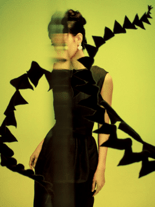
    Photograph by Harold Julian for The New Yorker

    I love the use of McGuffins as a plot device in storytelling. It gives instant motivation, and when used well, can give valued insight into a character’s constitution as they seek the MacGuffin. (In case you aren’t aware what a MacGuffin is, think of the Maltese Falcon, Ark of the Covenant or the Death Star plans.)  I would argue that the Balenciaga dress in Han Ong’s “My Balenciaga” is the same plot device, but used in a dramatic, rather that thriller/action, setting.

    The Balenciaga dress is owned by Lucy’s mother, who is a former fashion model from the Philippians. The mother received the dress many years ago while she was working as an international model, and confusingly, the dress does not contain a Balenciaga label in it, making its authenticity suspect. Lucy and her mother live with Lucy’s aunt on the Upper West Side of Manhattan, and the three lead a pleasant life in the City. The mother still continues to wear the dress on special occasion out, such as going to the Met to watch an opera. After the death of Nora Aunor, a Philippine actress, which affect Lucy’s mother personally, things begin to change in their home. For Lucy, she changes her appearance and tries on the dress, which fits her well, and soon her personal and professional life begin to develop in positive ways. Yet there is still a question over the dress’ origination.

    This is a story that hits all of its marks; it is a very competent work. Yet, I never felt like anything was at stake for these characters, such as there was no emotional peril for Lucy or her mother. I believe that Han Ong was trying to create tension with the dress by playing with the idea of “The Value of Myth.” (You know, like in “The Man Who Shot Liberty Valance” or “Lisa the Iconoclast”) What is more important; the truth about the myth, or the truth the myth creates? No matter which side of this question is answered, I felt that the characters would essentially stay the same. Hence, no tension or peril.

    Perhaps the story was a little too long, spending more time telling rather than showing, so to speak. And, unfortunately, I think you could have taken the aunt out of the story, and it wouldn’t have changed anything. But, I did enjoy the character of Lucy, and found her journey in the story compelling; the search for connection with her mother. Which is why I see the Balenciaga dress as this story’s MacGuffin.

  • Short Story Review: “I Am Pizza Rat” by Han Ong

    (The short story “I Am Pizza Rat” by Han Ong appeared in the October 23rd, 2023 issue of The New Yorker.)

    (There are SPOILERS!)

    Photograph by Melissa Schriek for The New Yorker

    As a kid who grew up in the 90’s, I am a sucker for slacker lit. You know, meandering stories, aloof narrators, whacky characters, and a general revelry for nothing happening… you know, whatever… Perhaps Kerouac created this genre of fiction with On the Road and Dharma Bums. And it’s a tough genre to execute. The form appears antithetical to the general format of short fiction and novels, as slacker lit just wants to stay mellow and float on down the road, but to work effectively, it still needs a climax. And it pains me to say this about “I Am Pizza Rat” by Han Ong, which is a charming and enjoyable short story, but lacks an effective climax, and leaves the end of the piece feeling flat.

    And I liked this story and the writing. The narrator is a fifty-one year old struggling writer who lives in New York City, but is out in San Mateo, California taking care of his seventy-six father who recently had a fall and is recovering. The writing has just the right tone of sadness and depression in it, but also a touch of irony and humor which never lets the story go too far in the dark corners. We meet the instructor of a FALLING NATURALLY class, and his pot selling brother, Bun (pronounced “Boon”) the African nurse, members of a Gilbert and Sullivan Group, and the idiosyncratic routine of an elderly father. And there are animal videos. But at its core is a father and son story, and slowly the life of the father is revealed, and the trauma he experienced, and how he made imperfect efforts not to pass that along to his son. And the son is aware that his father tried, and mostly succeed, at ending this cycle of trauma.

    This is all great stuff, which makes the climax all the more disappointing. I read the story twice, and decided that the climax is the last paragraph of the second to last section. See, the father asks the son where he goes when the nurse comes to the house, and the son replies that he goes to the university library and has started writing again, thus gaining his confidence back. Then the narrator goes on to say in the same paragraph, “In stories, books, I’m a sucker for the moment when the dormant character awakens.” As if this ironic “wink and a nudge” of a line is to suffice as the “realization moment” in the “Hero Cycle” where the hero has changed from the events of the story, thus leading to the resolution. Unfortunately, this lands hollow as the action is told to us, and not shown. This choice feels lazy in an otherwise active slacker story.

    Look, endings are hard, and I don’t believe this ending “ruins” the story. It’s just more like a record scratch in an otherwise very good song. There are moments and observations in here that Han Ong shows a deft hand with. Especially with the father/son relationship, which is the core reason I would recommend reading this story.