You know what “writing advice” I hate getting more than anything? “Less is more.” And the hair’s breadth of a runner up to that infuriating maxim is, “Show don’t tell.” These two bits of advice are the Tweedledee and Tweedledum of the writing world, who get marched out by lazy editors and inept writing instructors when they need to say something enigmatic yet mildly profound, which can be interpretation in any way, other than with a coherent explanation. Those two phrases have been used so often, that the words have been rendered meaningless.
But then Heather Bell Adams writes “What Kira Packed,” and finally, there is an articulate, rational, and svelte work of flash that says in a clear voice – this is how you write less without telling.
This piece is under three hundred words, using a structure devise of what Kira packed going to and then back from “camp.” It is heartbreaking in its simplicity, knowing the “change” Kira endured at “camp” and how what she’ll be coming home with what may include trauma, repression, self-loathing, and depression. This is a gut-punch of a piece, a brutalist’s honesty here, but Heather Bell Adams also leaves just enough vague, forcing us to use our imaginations to fill in what is left undefined. This creates a unique and individual horror for each of us as to what “really” happened at this camp.
This is how you do it, and do it impactfully, with intent to get to the marrow of a story.
(This is a Flash Fiction piece that I am releasing to the world…)
No matter what we do, the dog always smells bad. And when I say, “smells bad,” it’s a smell combination of a “wet dog,” and corn nuts. We bathe her with expensive shampoos and conditioners, one’s specifically for serious, industrial grade dog odor. It only holds for a day or two. Then she returns back to her stink. Sometimes with a smile.
We asked the vet about it, and she said that some dogs smell – it’s just who they are. But she ran a couple of tests anyway, to make sure there wasn’t an infection or something worse. Nope, the dog was fine. Her teeth and gums were fine, bloodwork was fine, pee and poop was fine. No signs of infections or parasites. No cancer, no ticks, no fleas, nothing. The vet suggested that we change her diet, maybe that would help. And to be safe, the vet thought it best to shame us – “This is who your dog is, maybe you should learn to accept her.” I accept the dog, just not the smell.
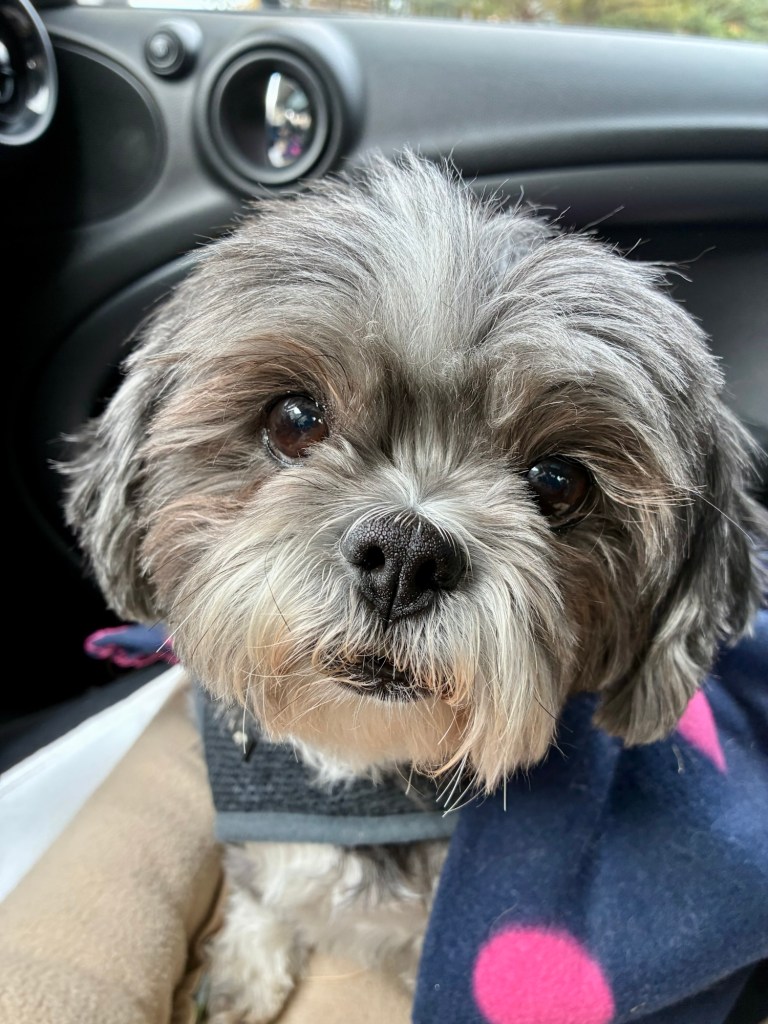
She’s a mix of shih tzu and something else small. Maybe a chihuahua, maybe a wiener dog. We rescued her from a puppy mill, or at least that’s what we were told when we adopted her. She was a sad sack of a lost cause – a little under fed, and not looking happy to be rescued. While the other dogs wagged their tails, and jumped for attention, our dog just lay there on the cold linoleum floor – looking like she’d given up on life. She didn’t exactly exude the traditional joy and happiness that a dog brings to your life. She was giving off a “I’m going to get picked last” vibe. What can I say; I was always picked last. It just seemed fitting.
We wanted an animal in our life; my wife wanted a dog, and I wanted a cat. The animal adoption event at the Paramus Petco only had dogs, though the Facebook posting said cats would be available. But when you walk on the lot, you gotta buy. We just assumed that the bad smell was due to neglect. How were we to know it was a factory setting. We made sure we added pet shampoo to our overflowing cart of pet supplies at the store.
She was nervous to come home with us; shook the whole way. The wife wrapped her in a blanket from the trunk to see if that would calm her down. It didn’t. She shivered but didn’t make a sound. At home, we fed her and bathed her, and let her explore our apartment. We sat on the couch and watched her sniff around wondering what she would do next, which was to take a big poop in the middle of the living room. In hindsight, we should have walked her when we got home.
Walking her was an enlightening adventure. We discovered that our dog hated all other dogs. Our little dog displayed a level of animosity and rage that I didn’t think was possible for an animal. She would growl, hiss, and bark. Spit would fly out of her mouth, and her fur would stand up. Possession might be a good word to use – as it was like the Devil entered her body. And it didn’t matter what the other dog’s reaction was, our little guy still wanted to kill them. Once, she pulled so hard on her leash, she almost chocked herself out. So, walks became a game of avoiding other dogs.
Before you ask, yes we tried all the training tricks to get her to be more comfortable around other dogs. We tried treats, and positive reinforcements, a firm hand, and all that other dog whisperer shit. Nothing took. We had a neighbor in our building who was a dog walker. She was positive she could train our dog. After three days, even she gave up. And she couldn’t figure it out either. Why was the dog so nice to people, but when another dog came around, she devolved into a demon? It’s just who she is, we told the neighbor, and we accept that this is who she is.
My mother was a nurse, and she loved helping people. It wasn’t a job; it was a calling. I say this because she told me often that she never saw people at their best. When you show up at the doctor’s office, and especially at the hospital, people are usually at their worst, and don’t always behave well. She would try to approach each patient with a level of empathy, knowing that the person just wanted to feel better, and a little kindness goes a long way. Reading Angela Kubinec’s flash fiction story “To the woman who conducted my disability benefits interview” touches on this theme, and uses a format to reinforce that idea.
Three main tenants landed with me as I read this piece. First is the protagonist/narrator who wrote this letter to the social worker. I was touched by the humanity of this person. Though it is never fully identified what the disability is for the protagonist, medication bottles and past delusions are mentioned, so a possible mental disorder seems applicable. This character has a nervous frantic energy, but at the same time feels like they are doing their best to hold it all together. Through it all, charming bits of humor and vulnerability peek through. The second part of this story that intrigued me was how the social worker is described in this letter. From the start of the story, the social worker’s annoyance is almost tactile, and she is covered in a harried tiredness which exemplifies a person who is overworked, and underappreciated in the essential job they perform. She is presented as a person who has seen and heard it all before when it comes to these interviews. This creates a simple yet very effective tension between these two, but humanity and sympathy still finds ways to bloom forth in this situation. This lead me to the third point, which is how Kubinec’s use of the letter as the structure to frame this story. Though this isn’t a formal letter, using this format elevates the emotional impact of this situation. The protagonist, the writer of this letter, states that this incident between them occurred years ago, implying clearly that these events have stayed with them. That this act of simple kindness has had weight and impact on their life. By using the letter format, or second-person narrative if you will, the social worker is the target audience, leaving us the reader in a role of witness to the protagonist’s unguarded honesty. It’s as if we are being let in on a secret, instead of being told a story.
“To the woman…” is the kind of flash fiction story that reminds me not to give up on humanity. Just a little sympathy and kindness can help others in immeasurable ways. Perhaps not the most original theme, but a vital one, and one that in the time that we live in, we desperately need reminding of.
(The flash fiction story “Bed Rot” by Sarah Chin first appeared on November 14, 2025 at Okay Donkey.)
If you read enough flash fiction like I do, you notice that a couple of subjects are rather popular with writers; death, pets, and breakups. This isn’t a complaint, as I understand why – the three I named bring up strong emotions in people. Breakups are an especially tricky one, as the writer has to thread a very fine needle – don’t want to be too angry and come across as bitter, and god help you if you are too whinny. The best breakup pieces, I find, work in a healthy amount of humor to balance their pathos, which is why Sarah Chin’s “Bed Rot” is such a fun and honest work.
You can never go wrong with a good opening line, and here Chin delivers a sentence that at first hints at a promise of possibility only to end with the foreshadowing of what is actually to come. Word choice, and sentence length is used here to create a staccato rhythm that keeps the piece moving in spurts and prolonged moments. This creates a feeling that nothing is centered or even fully processed; that what the speaker is experiencing still has a level of shock to it, but also balanced with a desire to try and stay in control of their emotions.
Another aspect of the piece I enjoyed was following the path of thoughts the speaker has, and the logic it traverses going from subject to subject. From tulips, to the other woman’s name being Amsterdam, Martha Stewart’s idea of women and flowers, from the shedding of the brunch date outfit to be comfortable, and a little tulip madness thrown in. Peppered in each subject are dry comments, and observations that are sharp-tinted with a hint of anger, but tempered with humor. Nothing spins out of control, though it feels like it could, yet never does.
“Bed Rot” does stick to a structure which dramatically works very well. Each subject change, and snarky comment is building toward the climax of the speaker expelling this relationship and its confinement to her. What she is left with is a raw, more authentic self, thus completing this journey, and leaving us with the understanding that she will continue to grow and be fine.
I like being a dad. Fatherhood has been more rewarding than I imagined. And I will also say that parenting is harder than I thought possible because unforeseen changes seem to happen every three months. Just when I think I got it down, life with the kid takes a right turn. Though me and the wife had plans and best intentions, we learned that we weren’t in control. Reading Emily Rinkema’s cute and humorous “13.1 Septillion Pounds,” I was reminded of all of those emotions, especially when our kid was still a squirmy baby.
The premise of the story is that two parents go to wake their baby only to find that the child has written math formulas and equations on the walls the night before. The math is accurate, as two mathematicians arrive and verify. I feared this setup was going to lead to a one-note joke; kid does something crazy therefore the parents have a crazy reaction.
I needn’t have worried.
What the story is playing on is the unintended consequences of the parents’ well intended actions. Perhaps the Grandma was correct and the child is just gifted, and this situation would have come about inevitably. Or, maybe it was the mobile displaying the galaxy that influenced the baby? Clearly the basketball that the father left in the crib helped the child formulate the weight of Earth. Though I’m not sure I know a parent that would leave a Sharpie in their child’s crib, but hey, I can let that one go. The truth, and the humor for that matter, of this story lies in an honest fear and hope that parents have; they hope their children will do better than them, but fear that in succeeding the child will become someone they won’t understand.
The conclusion that the parents reach is correct, and one which makes the world right again. It is wholesome, right and honest, all the things that I hope parenting is. Most of the time, I have no idea what I am doing as a father. It’s a scary tough job. But being able to help my kid become who they are is a deep and profound privilege. It’s just a really bumpy ride that loves to make a bunch of turns.