Tag: Book Review

  • Short Story Review: “The Queen of Bad Influences” by Jim Shepard

    (The short story “The Queen of Bad Influences” by Jim Shepard appeared in the June 16th, 2025 issue of The New Yorker.)

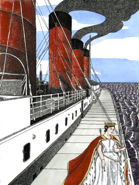
    Illustration by Naï Zakharia

    Reviewing stuff is fun. Clearly, because I do it often. Who doesn’t like sharing their opinion and acting like an expert? It’s all fun and games until you hit a critical theory paradox; Is it possible to acknowledge that a story is good, and well written, but at the same time does not resonate or move me? That was the situation I ran into when I finished reading “The Queen of Bad Influences” by Jim Shepard.

    To be clear, “The Queen of Bad Influences” is a good story, well written, and I have no qualms in recommending that you should read this story because it has a very relevant theme, is constructed well, is insightful, has a bit of action and tragedy to it, the protagonist is engaging and grows over the story, and the use of language is spot on. All the boxes are checked here.

    Yet, I just didn’t feel anything.

    Look, I write these reviews for my own enjoyment, and as an exercise in analyzing what makes a short story work, or not work, so I might improve my ability as a writer. On the whole, I will only review a work if it moves me, garners an emotional reaction, either positive or negative. If I don’t have a reaction, then I let it go and move on. (Now, if someone wants to pay me, I’ll review whatever you send me.) These aren’t deep philosophical rules that I follow, but more like functional guidelines.

    When I finished “The Queen of Bad Influences,” I didn’t have a reaction to it. At first I was going to write something negative about the piece, but the more I thought about it, the more it didn’t seem accurate to do it. I went back through the story, and I really couldn’t find a fault with it, save one line, but that wasn’t that big of a deal. What I came to accept is that this isn’t the story or the writer’s fault, it’s me. This is just not my thing.

    Let me try putting it a different way, which my Gen-X grunge mind can appreciate; “The Queen of Bad Influences” is like Alice in Chains. I get why people love the hell out of Alice in Chains. Alice in Chains was made up of some really great musicians, who wrote some really great songs. I’m not an Alice in Chains fan because they suck – I’m not a fan because they don’t resonate with me the way Nirvana, or Pixies, or a host of other grunge bands do. It’s me, not them.

    It’s me, and not Jim Shepard and “The Queen of Bad Influences.”

    Anyway, go read this story. You’ll enjoy it.

  • Personal Review: “First Love” by Gwendoline Riley

    For the life of me, I don’t remember who or what recommended First Love to me. It was on a list of books that I should read, and when I found a copy of it at the Strand, I picked it up without a second thought, nor having any idea what I was about to get myself into. To be honest, I appreciate the joy and excitement that comes from reading a book that I know nothing about, by an author I also know nothing about, because it does afford me the ability to truly experience a work without any preconceived notions. In this situation, I didn’t even read the description on the back of the book.

    First Love isn’t about the “happy” side of love. It’s not about the joy, fulfillment, or really any of the positive side of love. Oh, now and then, that side of love does show up, but on the whole, that’s not what this novel wants to explore. For the protagonist Neve, she shares with us all of people that she first experienced a form of “love” with; her mother, her father, a boyfriend, and her husband. Each relationship is troubled, difficult, in some cases even toxic, and they all overlap on each other, influencing each relationship from actions that happened in the past, and fears of what might happen in the future. For this reason, it is not a traditional novel, and time and events shift – nothing is linear here, but it adds greatly to the theme of these loves bumping and conflicting with each other.

    I found myself thinking about the works of Rachel Cusk and Maggie Nelson as I read this book. Riley’s novel tackles a serious subject, but the narrative never becomes weighed down, as it feels like a conversation. As such, this book was akin to the Outline Trilogy, and the examination in Bluets. It felt very internal, that we were being let in to very personal thoughts and exanimations. I will say that though First Love is a new form novel, like Outline, Riley did have a more traditional climax here, which gave the novel a satisfying conclusion.

    When I read a book like First Love, I am rather envious of writers like Gwendoline Riley, who create drama and self-examining characters, while never making their stories so personal that it becomes dull of whiney. It’s a bit of a magic trick, that is fun to experience. Thank you, to what, or whomever put this book on my reading list.

  • Personal Review: Let Me Think by J. Robert Lennon

    I am embarrassed to say that I have no idea how Let Me Think by J Robert Lennon made it on my reading list. And my reading list is actually a wish list on my Amazon account. This was the book that was next up. I knew it was a collection of short stories, but other than that, I knew nothing about the author or any previous works. I was going in blind, but sometimes it’s good to be surprised.

    The collection is made up of flash pieces and short stories, broken up into five sections. There are two reoccurring stories; one about a marriage, and another about a cottage in the woods. The other thing that reoccurs in the collection is the theme of unhappy marriages. And I can’t prove it, but with the book being broken into five parts, I had the weird feeling that each section was to represent one of the five stages of grief. Again, no proof of that, but I couldn’t shake that idea.

    I liked Lennon’s writing right from the beginning of the collection. The first two pieces, “Girls” followed by “Boys” showed that Lennon has a sense of humor, and likes to play with the form of a short story. Witty, this guy’s witty, and the sense of playfulness and fun comes right through. That’s not to say that the none of the stories take on a serious tone, as some do, but experimentation is happening here as well. The “cottage” stories do take on an adult tone, but they also lean into a slight thread of absurdism, or maybe fanciful is the better word to use. Yet, the best example of this tone is the story “Subject Verb” which is told in that very simple sentence structure; just a subject and a verb. It is a format that is brutal in its simplicity, but Lennon makes it an effective tool for storytelling.

    In the end, the collection was enjoyable and entertaining, but what I was left with, and made me the happiest, was that this was a book by a writer who is trying to find new ways to tell a story. The pieces don’t follow the hero cycle, or have a hook in the first line, or even try to tie up the narrative with a button. Now, some of the stories do the afore mentioned things, but the ones that don’t, the stories that try, and poke and prod at what a narrative can be – how short can a story be – how many words are needed to create an emotional pay off? THAT was the excitement of reading this collection – it was different, and it was refreshing without feeling labored to be different.