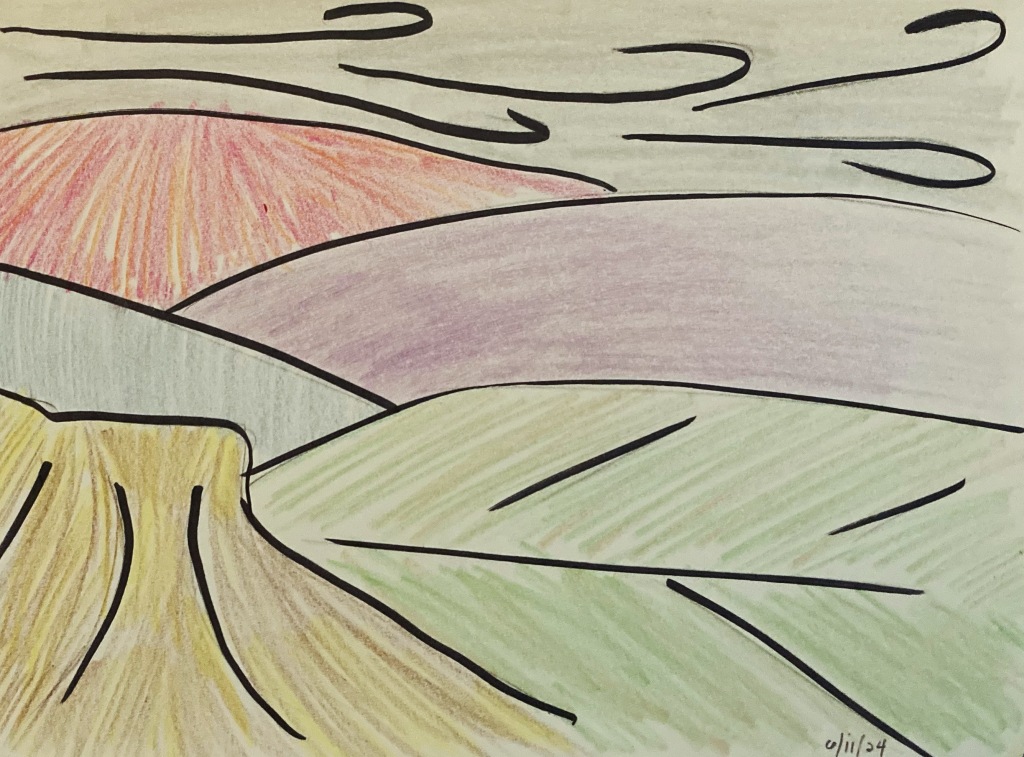
Landscape – pencil, marker, crayon on paper

Today’s sketch is based off a painting by Gabriele Munter.
Crayon, Pencil, Marker on Paper
(The flash fiction story “Poetry Is Not About the Price of Gasoline” by Amorak Huey appeared in Okay Donkey.)
I am aware that I should know this, but sometimes I just am not sure what the difference is between absurdist literature and postmodern literature. Some of my favorite writers fall into one, or the other, or both of these categories. And I don’t want to get started about what makes something post-postmodernism or post-irony.
So, what is “Poetry Is Not About the Price of Gasoline” by Amorak Huey? I guess you could define it with one of the above terms, but that feels like a pointless academic exercise. What the piece reminded me of was how many people see poetry as a useless commodity, while gasoline, especially the price of gas, commands an important space in their daily lives. This juxtaposition is humorous, though it does leave a bitter aftertaste in the realization how poetry is vastly undervalued. Not a revolutionary observation, but it is presented well here, especially with this wonderfully encapsulating line:
“Which is to say this poem is nine-tenths of the way to being yours, with the final tenth of the process being determined by the rest of the laws, the ones written—like poems—out of language and granted meaning by our need to have shared words for how we interact with each other.”
And then those baboons somehow got on that flight to LA.
(The story “This is a Dog” by Joanna Theiss appeared in Milk Candy Review.)
It is hard to pack an emotional pay off in under 1,000 words. Not impossible, just hard.
Joanna Theiss does this rather masterfully in her flash piece “This is a Dog,” which is one of the best examples of a story paired down to the essential, the marrow of it, and at the same time, leaving enough gaps for the reader to fill in, thus allowing the story to come alive, and have an impact.
The story is about a dog, if you couldn’t figure it out. And it’s about loving another, and the hope that you did right by them, maybe never knowing for sure.
Theiss does use a story trick of starting each sentence with “This is…” I’ve seen this type of trick before, from armature writing groups to the pages of The New Yorker. Yet, I will say that Theiss does it correctly. The “This is…” creates a rhythm to the story, helping it charge ahead, and as the piece progresses, the “This is…” begins to take on different meanings from the narrator. Also, Theiss structures her story very well, dividing the piece in five sections, each with a specific narrative function, that not only builds to the climax, but lands perfectly at the conclusion. And that conclusion also nicely ties up the “This is…” motif, making the whole story feel that we have completed a journey with the narrator, who has been changed forever by the events.

